Modern Star Trek Round Up

TLDR: If you liked older Trek, go watch Star Trek: Strange New Worlds.

Something that Modern Star Trek and Modern Star Wars seem to share in common:

Modern takes on these franchises often seem to be poorly received by their fandoms.

I’m not the type of person to crap all over someone else’s art with my opinion. After watching some awful modern attempts at Star Trek, I’ve found myself staring at after-show credits thinking to myself: “That was garbage. How the hell did this get made?”

In the Beginning, There was T.O.S

The Original Series only ran for 3 seasons, between 24 and 29 episodes per season costing about $180k 1966USD’s per episode to produce. Originally considered a failure, Star Trek found its audience through syndication.

The episodic anthology used space exploration as a backdrop to explore geopolitical topics at times and in other times as a setting for silly futuristic adventures. In doing so it sparked the imagination of millions and set off one of humanity’s most iconic entertainment franchises.

TNG Era

Star Trek: Next Generation evolved Roddenberry’s vision of a utopian human future into 7 seasons of 26 Episodes spanning 8 years. With DS9, Voyager, there are Star Trek on ramps for the 90’s and 2000’s kids as well.

Big Screen, Mixed Results

As Star Trek was adapted for the big screen, the box office results were often flat. A few were critical successes (Star Trek: The Motion Picture & Star Trek 2: The Wrath of Khan) but the rabid fandom failed to translate to large box office earnings. 2002’s Star Trek Nemesis barely eek’d out a profit, eventually - maybe. The Studio decided it was time to make a change.

Production budgets vs Box Office

(Contemporary adjustments for inflation in bold)

Original Series

Star Trek: The Motion Picture
Budget: $46 million — $152.5 million
Gross: $139 million — $460.7 million

Star Trek II: The Wrath of Khan
Budget: $11.2 million — $27.9 million
Gross: $97 million — $241.9 million

Star Trek III: The Search For Spock
Budget: $16 million — $37 million
Gross: $87 million — $201.5 million

Star Trek IV: The Voyage Home
Budget: $21 million — $46.1 million
Gross: $133 million — $292 million

Star Trek V: The Final Frontier
Budget: $33 million — $64 million
Gross: $63 million — $122.3 million

Star Trek VI: The Undiscovered Country
Budget: $27 million — $47.7 million
Gross: $96.9 million — $171.2 million

The Next Generation

Star Trek Generations
Budget: $35 million — $56.8 million
Gross: $118 million — $191.6 million

Star Trek: First Contact
Budget: $45 million — $69 million
Gross: $146 million — $223.9 million

Star Trek: Insurrection
Budget: $58 million — $85.6 million
Gross: $112.6 million — $166.2 million

Star Trek: Nemesis
Budget: $60 million — $80.3 million
Gross: $67.3 million — $90 million

Reboot, the Kelvin Timeline

Star Trek
Budget: $150 million — $168.3 million
Gross: $385.7 million — $432.6 million

Star Trek Into Darkness
Budget: $185 million — $191.1 million
Gross: $467.4 million — $482.8 million

Star Trek Beyond
Budget: $185 million
Gross: $318.1 million (to date)

ref: Reddit Post

Help Me JJ, You’re my Only Hope

(that’s going to piss some people off, lol)

Bad Robot

The Studio flipped the keys of NCC-1701 to JJ Abrams and the result was 2009’s Star Trek and the beginning of the Action Trek era that persists today. The idea was to expand the appeal to the average summer blockbuster moviegoer. The 2009 film was a refresh of TOS, a reimagining…. a.. (ffs) reboot. (Big Sigh) It would borrow from the past but adapt Star Trek to the modern ADHD / Twitter addict sensibilities. Young and sexy actors right off of underwear-model gigs, giga-hours of CGI render time, a soaring music score underpinned with rock-hiphop contemporary staples and lens flares for days.

Modern Trek takes the dramatic pacing of Breaking Bad, mixes two parts Calvin Klein commercial, two parts “pew pew pew pew space lasers!”, one part X-Games and one part canon-breaking technobabble to create the red bull commercial in space that is modern Star Trek.

I know that all sounds negative, so I should put my cards on the table here. I like the new cast and I like the sensational visuals and over-the-top sound design. I just sort of hate that Star Trek on the Big screen usually has: First Act: Long, lingering spaceship-Porn showing the ship docked at some amazing StarBase and Third Act: Same amazing space ship gets exploded or crashed into a planet in a narrative sacrifice. Seriously - Get a new story, already.

The Abrams era Star Trek films appear to have been successful at the Box Office despite some story stuff that does violence to Trek canon. In Abrams Trek, you can bring people back to life with a super blood transfusion; transwarp beaming can send an individual (or bombs) to seemingly anywhere. “Whatever”. Star Trek has always played fast and loose with the rules.

Star Trek Discovery

Star Trek Discovery centers around the hi jinx of Spock’s secret adopted sister. Discovery is a TOS era ship equipped with an experimental spore drive that allows the ship to transport itself through a cosmological mycelial network to nearly anywhere in the known Galaxy. “Black Alert!” Because: magic mushrooms and tardigrades. If it sounds stupid, well: that’s because it is.

That aside Star Trek Disco is sort of a mixed bag. Michael Burnham (Spock’s secret sister) has this space Jesus thing going that can be a bit much at times, despite the fact that I genuinely like the actress that plays Burnham: Sonequa Martin-Green. In fact, I like most of the casting on this show. Doug Jones plays a Starfleet officer named Suru and his physical performance goes a long way to make Saru believably alien, not just another dude with plastic crap glued to his face. Anthony Rapp plays the ships engineer (Staments) with a believable tinge of Aspergers. Wilson Cruz plays the ships’ doctor (Culber) and Stamet’s love interest. They have pretty great “opposites attract” chemistry and their relationship makes sense within the story.

Discovery Season 1 establishes Burnham’s character and explores the Federation-Klingon war.
Discovery Season 2 is a time-traveling / runaway AI story.
Discovery Season 3 is a dystopian future story.
Discovery Season 4 is the story of the future dystopia making a turn back towards core federation values.

Star Trek Picard

As a fan of STTNG, I looked forward to character study of Jean Luc Picard. Instead… we got something else.

Picard Season 1: The JL Apology tour
This season introduces the viewers to an even further aged-up Jean-Luc Picard. It introduces us to a new crew of younger characters. The casting on the new characters is good but there are some truly baffling writing choices in this show. One character: Raffi, lives in a trailer, smokes snake leaf and has a frustratingly over familiarity with Picard. She calls him ‘JL.’ One admiral that I’m going to call “admiral bitch face” just cussed Picard out when he comes to her with valid concerns. Picard spends the majority of the season just sort of meandering between plot contrivances. Patrick Stewart’s charisma still comes through at times but it mostly overshadowed by the dark and violent mood of this series. One side character gets his eyes forcibly removed, while he’s awake. Plenty of disintegrations, decapitations and death. One bright spot is seeing Jonathan Frakes and Steward together on screen. Riker is always a joy and has some great line delivery. I’d also love to build his pizza oven in my backyard. One day..

Picard Season 2: The Voyage (Sorta) Home
I came into the second season ready to overlook the numerous shortcoming of the first season. First seasons can often be shaky until a cast and crew finds their groove. Stewart has better energy and people spend less time bitching him out this season but the overall story still feels like something written as part of a middle-school writing contest for a free personal pan pizza. This season is a time travel plot that brings the characters to our near future, much like The Voyage Home. Also like The Voyage Home: Season 2 explores social commentary and contemporary issues such as the wild fires in the Western states, climate change in general, CBP abuses of illegal immigrants, poverty, healthcare & the pitfalls of late-stage capitalism. Unlike The Voyage Home, this season of Picard explores takes on these issues without any nuance, proposes no solutions and isn’t particularly fun. You never get “nuclear wessels” or “double-dumb-ass on you” moments that you got in The Voyage Home. You could watch the 1st, 2nd and final episode of Season 2 and not miss much. Worst of all, John Delancey never really shifts into the mischievous gear.

Star Trek Strange New Worlds

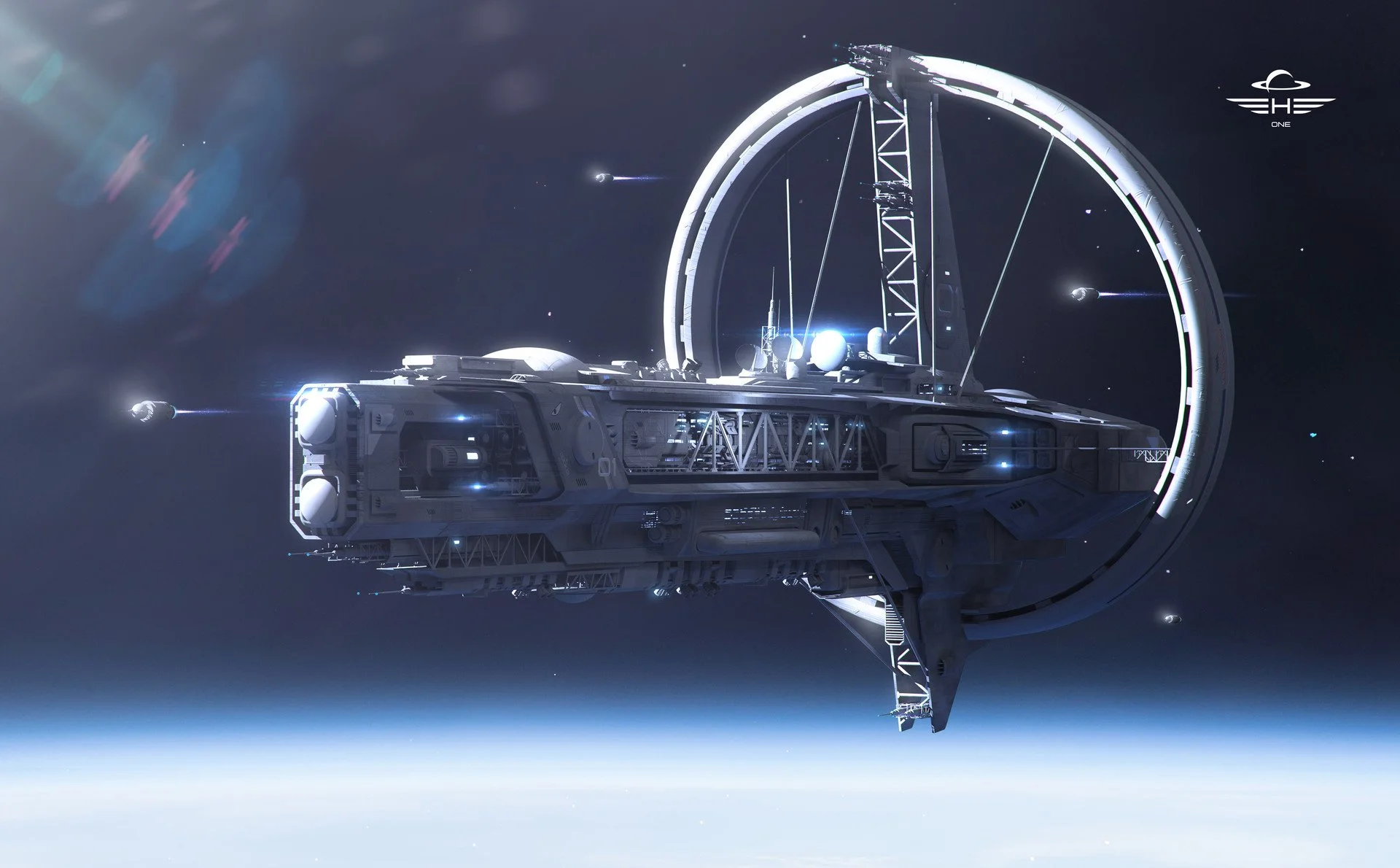
Star Trek Strange New Worlds is a refreshing entry to modern trek. The cast is great, the story is good, the enterprise looks amazing and the overall “feel” is Star Trek. It is a campy, optimistic romp through the stars and a true return to form for Star Trek.

Stranger Things Season 4

Stranger Things Season 4 dropped this weekend. It. IS. GREAT.

Mild spoilers in the form of context-less stills below. If you are severely spoiler averse, come back after you’ve seen Season 4a (up to Episode 7).


                                  88 88                        
                                  "" 88                        
                                     88                        
,adPPYba, 8b,dPPYba,   ,adPPYba,  88 88  ,adPPYba, 8b,dPPYba,  
I8[    "" 88P'    "8a a8"     "8a 88 88 a8P_____88 88P'   "Y8  
 `"Y8ba,  88       d8 8b       d8 88 88 8PP""""""" 88          
aa    ]8I 88b,   ,a8" "8a,   ,a8" 88 88 "8b,   ,aa 88          
`"YbbdP"' 88`YbbdP"'   `"YbbdP"'  88 88  `"Ybbd8"' 88          
          88                                                   
          88                                           

(in portrait mode - that renders wrong but I’m not going to change the whole site template for one ascii gag)


I’ll be somewhat vague on details here so as not to spoil specific plot elements, though these stills may reveal story and character beats.

Bias up front: I was a kid in the 80’s, from Indiana. Stranger Things is high-grade, pure-cut nostalgia crack for someone like me.

Stranger Things Season 1 was an incredible achievement. In many ways it kicked off an entire genre of nostalgia-bait lookalike projects that often fell flat. In my opinion, Seasons 2 and 3 did a good job at character work, delivered some entertaining moments but lacked some of the thrill of the essential mystery of the first season. There is a formula to it and the formula gets to be pretty obvious.

That formula usually looks something like this:

Hey, Remember the 80s? -> Characters Pair off and Adventure -> Eleven screams and force-chokes a portal -> Roll Credits and Synth Track.
Despite my love for the material I have to admit I’ve been giving my Netflix subscription the stink-eye lately. The subscription cost keeps creeping up while the utility and entertainment we get from Netflix keeps falling. I often see Netflix properties as Great-Value Brand knock-offs of better shows. They’ve hooked me and cancelled several series without providing adequate closure. To the point that I’m often hesitant to engage with newly buzzing series; defense against future rug-pulls.

As of episode 7, Stranger Things Season 4 is an incredible outing for the series. If they stick the landing, it may be the best yet. Netflix spared no expense, spending an average of $30 million per episode and it shows. After watching the series, I’m going to cut that Netflix subscription some slack.

The show continues to do an incredible job of period-accurate set pieces and scenarios. Drawing inspiration from classic 80’s movie, television, music and culture. Not just in subject matter, either. The Duffers continue to nail the aesthetic.

I always appreciate a good period film (Chernobyl, for instance) and Stranger Things excels at this by leaning into period-accurate sets. The video rental store is a really nice touch.

Some of the techno-babble stretches credibility for 1986 tech. “IP-Geolocation” is mentioned. NSFNET was live in 1986 and used early TCP/IP implementation through fuzzball routing but there were only 6 nodes and (probably) no meaningful interconnect between NSFNET & ARPANET-MILNET. I mean, famously the ICBMs control silos still used 8” floppies in 2014. Hopefully that EM shielding on the silo control bunkers is top-notch.

(Pushes up my nerd glasses...) But, I digress…

The episodes are biggie-sized, coming in at an hour or more per episode. The pace feels right and the show never felt like it was running out the clock. It is refreshing to see a show take the time it needs. “Good, Fast or Cheap - Pick 2” We got great, long and expensive and I’m here for it.

Season 3 wrapped towards the end of the 2018 and Season 4 was protracted and delayed b/c of COVID-19 impacts on the industry. In terms of casting there have been valid concerns that the extra four years of real time would strain believability in such young characters. Through lighting, make-up, costume, practical effects and shot-framing the production crew did a great job of accounting for the actors ages. Millie Bobby Brown is a charming young lady these days but they make use of story-grounded reasons to dress her in ways that obscure her age. Through loose-fitting hand-me-downs or other scene-appropriate costuming, you forget that she’s 18 now. It doesn’t hurt that MBB is an incredible performer. At the extreme, Charlie Heaton is 28. Some of Heaton’s IRL pharmaceutical shenanigans have diminished his youthful appearance. The writers lean into that in a clever and fun way to even make Jonathan’s age believable. Joe Keery (Steve) is 30 but has a Toby Maguire thing working for him.

This season nods to classics like Nightmare on Elm Street, Carrie, Evil Dead, Amityville, Munsters, IT and much more. Robert Englund (Freddy Krueger) even plays a Character named Victor Creel. Despite the influences, the story never feels like a cheap knock off. The writing on this show is expertly crafted and character moments are interwoven brilliantly. Be warned though, this season leans more into horror territory than the Goonies-esque adventure start of the franchise. If you get easily squicked out by body horror, you may not enjoy this ride. It never feels gratuitous, though - the point of the horror is to establish the stakes.

The light and sound design of this season are incredible. At times, the audio-video experience here is downright visceral and almost always in service to the story. Lighting is usually period-appropriate with incandescent warm glow. Computer monitors and TV’s usually have scan-lines. Though, I suspect they may actually be LCD/LED panels installed in old chassis with black borders and a filter to produce edge distortions. The sound design makes great use of ambient hums and electrical clicks to bring extra intensity and to highlight “power up” moments. They often lean into practical effects and the attention to detail is quite remarkable. There are some digital-de-aging shenanigans on display and they usually work quite well. Clever cuts between old-vs-young keep shots from lingering too long on de-aged subjects and do a good job of hiding the uncanny valley of video-game-like faces.

Shot-blocking and composition are particularly inventive this season. There are some outstanding scene transitions, also in service of the story and designed to clue to viewer into plot details. Thematically, there is a two-sides motif that is often aided by the rotational transitions between Hawkins and the Upside Down. Low camera angles can establish hero shots or be used to put the viewer into the perspective of a child and they use this brilliantly. They often lean into zoom shots instead of dolly works, the zoom-pulls and pushes being a staple of 80’s horror.

The soundtrack is very good - and you guessed it: also services the story. You’ll notice Kate Bush climbed the iTunes chart to Number 1 this week in part thanks to in-story use of one of her songs.

The show explores the 80’s Satanic Panic and Parental overreaction. It also explores Bullying and the “Other-ification” of people, conformity and demagoguery. These things could be mirror-allegories for modern times but the Duffers are here to entertain, not preach - and it all lands without being overbearing.

Honestly, after a month or so of force-feeding my eyeballs some truly laughable modern content: I found Stranger Things Season 4a to be a brilliant and refreshing departure. The writing is excellent, the old characters are even better and new characters really hit the spot. A new character, Eddie - immediately became one of my favorites. Argyle and his not-quite mystery-machine van are a nice addition, as well.

Much like the Purple Palm Tree Delight, Stranger Things Season 4 is a real treat.

Two great podcasts to check out:

As always, I’m a big fan of the guys over at Bald Move:
https://podcasts.apple.com/us/podcast/dungeons-and-demogorgons-a-stranger-things-podcast/id1296708934

The Streaming Things Podcast is also quite entertaining:
https://podcasts.apple.com/us/podcast/streaming-things-a-stranger-things-podcast/id1291620241

PS5

I scored a (retail) PS5 last month. Pretty wild when you think about it that the PS5 was released in the end of 2020 and in the 1st third of 2022 they are still hard(ish) to come by; outside of scalpers.

My in, was the Best Buy Total Tech membership. I had signed up for it in order to get access to a GPU for a virtual pinball and gaming PC build. Aside from other benefits around warranty and rewards points, the Total Tech Membership gives you early access to hard-to-find things as they come into stock. The membership is $199/year (kinda steep IMO) but since I was able to buy an RTX 3070 and RTX 3090 at retail, it already paid for itself in my view.

At any rate, I’m not a huge modern console gamer but there are some touchstone titles that I feel compelled to play. On Sony’s Platform, for me: God of War & God of War Ragnarök are must-haves. The original game left such an impression, I was excited to revisit it with upscaled graphics in preparation for the new game this fall.

Astro’s Playroom

The PS5 is bundled with Astro’s Playroom. This game is great, especially considering the tenuous footing from which it was created. The point of the game is to acclimate you with the controller on the PS5 and the game itself is little more than a playable commercial for Sony PS merch. In it, you play as this little robot, Astro and explore hardware-themed levels and unlock Playstation memorabilia. That’s it. Doesn’t sound fun, but it really is.

The primary thing that makes Astro’s Playroom great is level design coupled with adorable characters. I know, that makes me sound like a pre-teen girl referring to a favorite stuffed animal but Im a 40-something beer-and-whiskey drinking nerd guy, unashamed to tell you the characters are cute. If you stop playing for awhile, it pulls out a little PS Vita or PSVR and entertains itself. At times, you can see the character shaking its little robot ass to the theme music of the stage you are on. All hail our future ass-shaking robot overlords.

Most gamers are probably aware of the history of Mega Man and its influence on level design that reaches even into modern games. Kitamura paid special attention to level difficulty, the idea being to allow the difficulty of the game to ramp up at a natural pace while maintaining a consistent-average-play-time per level. He wanted the game to teach the players how to play gradually, wanted to reduce the chance of players being stuck and frustrated and emphasized re-playability.

Astro’s Playhouse is a bit of a love letter to these early tenants of game design. The level design finds a balance of feeling open-enough to not be claustrophobic while balancing difficulty, skills and power ups to keep it engaging. Cute characters, good theme music and sound effects and quick respawns round out the experience to make Astro’s Playhouse a very fun game. (Despite being a giant Playstation Commercial.)

As a bonus, the PS5 is powerful enough to play Astro’s Playhouse while other games are installing. Pretty bad-ass.

Unreal Engine 5 City Sample

Unreal Engine 5 released a playable demo alongside the streaming and blu-Ray release of Matrix Resurrections. The UE5 City Sample includes cameos from Reeves and Moss and offer two modes: a playable car chase reminiscent of The Matrix Reloaded and a free-world environment to explore the City.

City Sample is available for free on the PS Store (search for Matrix Awakens) and the City Sample is available for download for free within the Unreal Marketplace. It includes assets, textures, models and examples to highlight UE5’s capabilities for film makers, creators and game devs.

Bobiverse Books


The Bobiverse Series

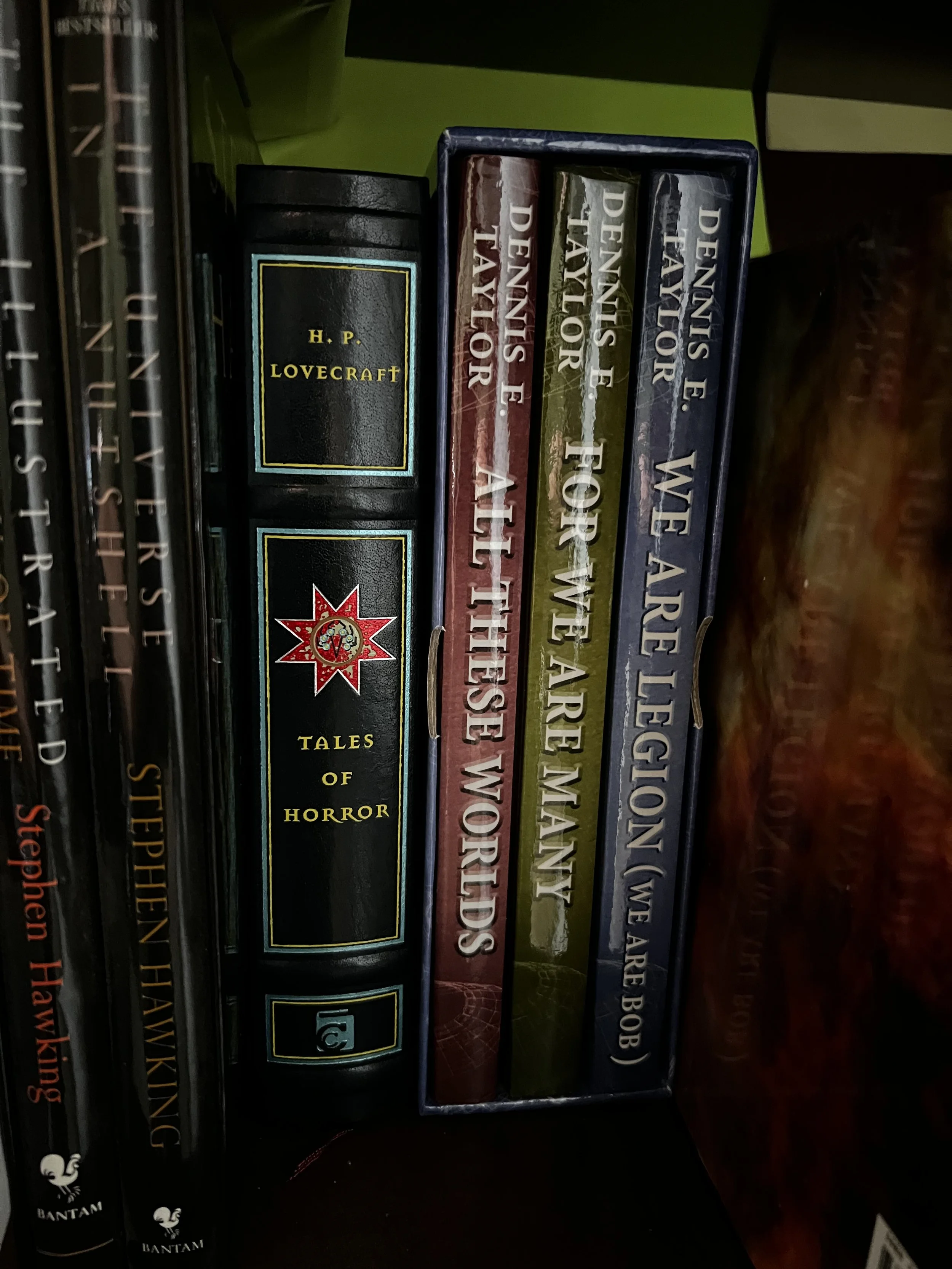
The Bobiverse is one part Ready Player One, one part Multiplicity, one part Bicentennial Man and one part Real-Time-Strategy game.

My first exposure to the concept of Von Neumann probes came from Nick Bostrom’s SuperIntelligence wherein a single-minded Artificial Intelligence replicates itself by exploiting natural resources in an exponential expansion into the cosmos.

What if, instead of an AI: the Von Neumann probes were bootstrapped from the consciousness of your run-of-the-mill middle-aged loner-ish nerdy programmer?

The Bobiverse series is about the exploits of the Von Neumann probe descendants of Robert Johansson as they set up shop in distant star systems, mine resources, build out interstellar infrastructure and balance exploration of the cosmos with the exploration of sentience.

I give the Bobiverse series 5 out of 5 quarters.

Free Guy

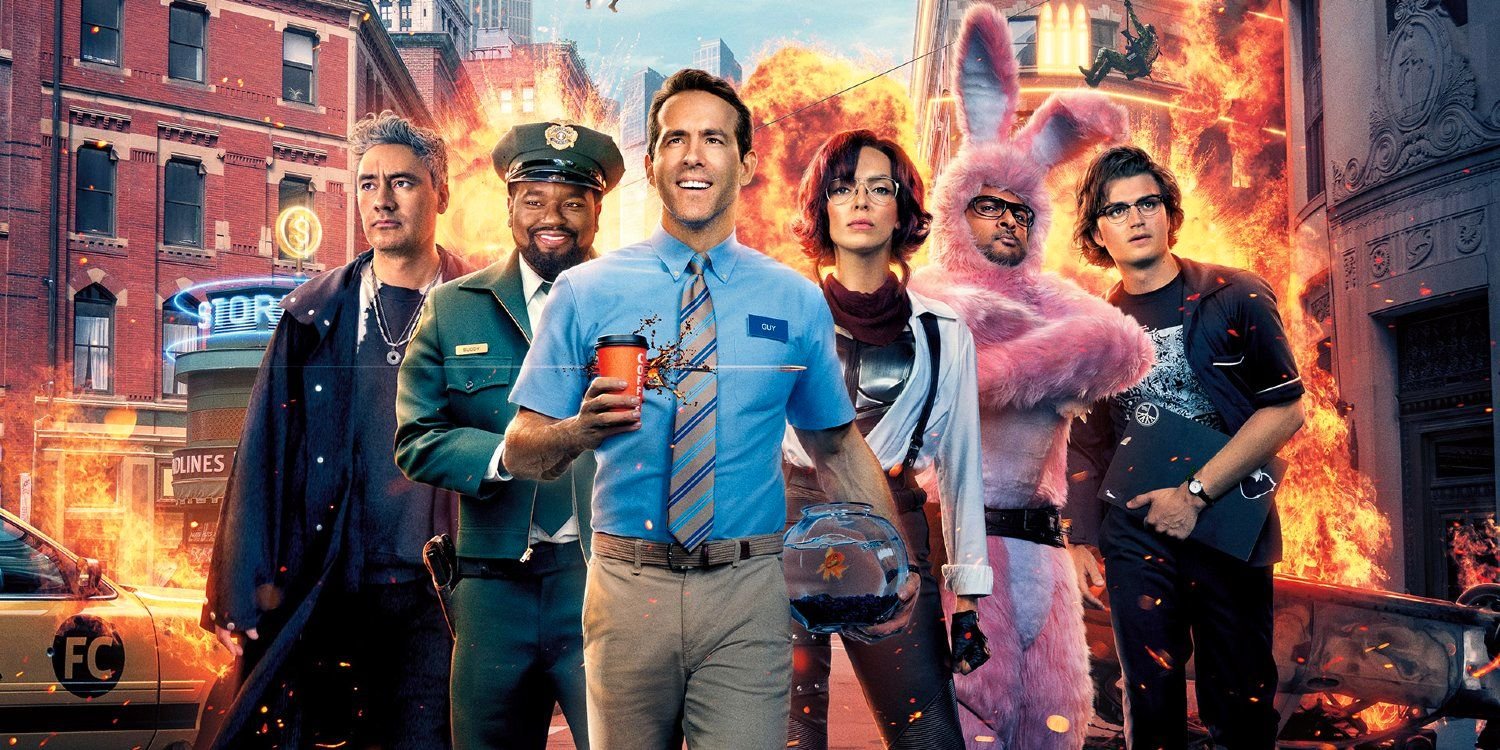
Free Guy manages to strike that balance of incorporating Studio-note-driven obligatory action set-pieces and storytelling for storytelling’s sake. The movie is fun, it has heart and it looks fantastic. In my opinion, Free Guy succeeds where the Ready Player One film attempts failed in adapting video game derived material towards a general audience.

Jodie Comer plays a programmer-turned gamer-investigator named Millie in Free City; a not-very-subtle nod to the Grand Theft Auto franchise. Following a casual interaction between Comer and Ryan Reynold’s Guy (an NPC), Guy becomes self-aware. The plot is advanced through the investigation of a mystery grounded in corporate greed, betrayal and hubris as Guy works to level up within the game by playing the normally violent game as a White Hat player.

As a fan of Reynolds, this movie pitches right over the plate for my expectations on humor and action. Joe Keery’s (Steve from Stranger Things) performance as a support debugger / programmer is really quite good and Jodie Comer brings a ton of charm to Millie’s character. Taika Waititi’s take on a douchey-dot-com tech billionaire is inspired.

The movie actually tells a good story with a decent moral. It is funny, stays pretty “safe”: it is definitely a family-friendly faire. Most surprisingly, the movie manages to have some heart. I found myself engaged with the characters through an ending that .. works.

I give it 4 out of 5 quarters.

Matrix Resurrections

I give Matrix Resurrections 1 out of 5 quarters.

When our only local Dolby Atmos / 4k Laser movie house announced that they’d be relegating this Matrix release to their 2k screens, I suspected this movie would disappoint. The first two times I watched it (in 4k w/ Dolby Atmos but at home) I was fighting a case of pinkeye-related light sensitivity. I walked away hating… no.. resenting this movie but suspected maybe it was on account of watching it through squinted eyeballs.

All healed up, I watched it a final time. Still don’t like this movie.

The beginning gave me hope. It was great seeing Reeves and Moss back in these roles. During the first Act, I can’t help but think of the ST:TNG episode “Frame of Mind” and the “is this a dream, am I going mad?” emotional thrill ride that Riker experienced. I warmed up to all of the meta-stuff in the first Act of this Matrix installment hoping they’d do something interesting with the Thomas Anderson: Make him question his own sanity and leave the viewer’s wondering: “Was this all a dream?”

During the second Act, I enjoyed the new cast members more than I expected but the third act was mostly a mess and to me, failed to deliver a good story.


Pros

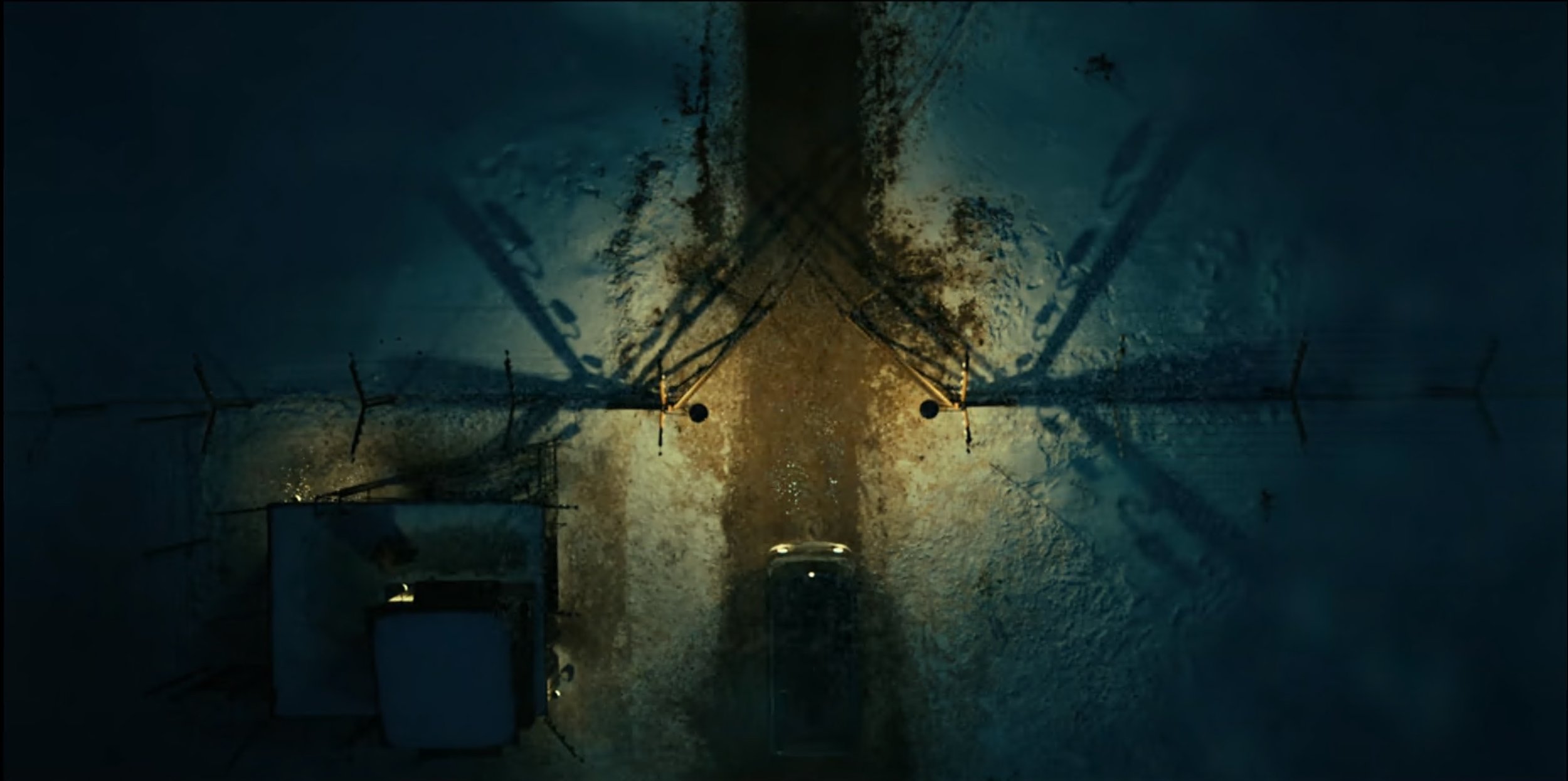
Opening Shot: Puddle, Reflection & Distortion - Nice!
Seeing Neo and Trinity again is a Treat
The new cast was better than I feared
Not properly explaining Neo’s lack of abilities
Doogie Howser as a Villain I dig it, NPH is a fine actor.
Swarm Mode: Neat Horror Visual

Cons

Distracting misuse of “modal” concept.
Smith doesn’t use the “Mr. Anderson” callout enough.
Homeless Merovingian? WWHHHHYYY!?!
Swarm Mode: A bit much.
Not properly justifying Trinity’s power levels in relation to Neo
Closing Fight Gag with NPH
Out-tro to a horrible cover of Wake Up.

Ultimately, The Matrix Resurrections wasn’t the worst thing I’ve seen recently but it also failed to live up to the hype. That (more than bullet time, even) appears to be the legacy of The Matrix sequels. The first installment was such a well told story with well executed cinematography, stunts & character beats that it has become an impossible act to the follow.

BattleZone!

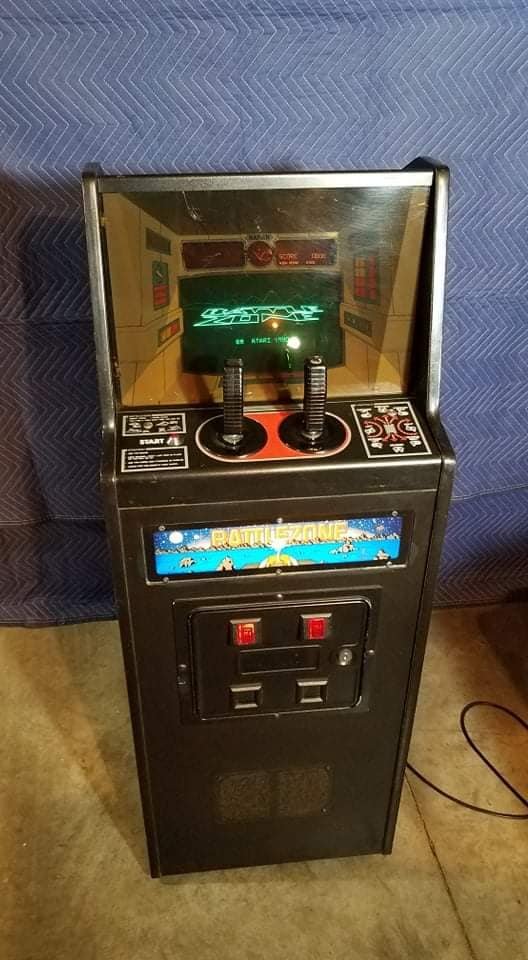
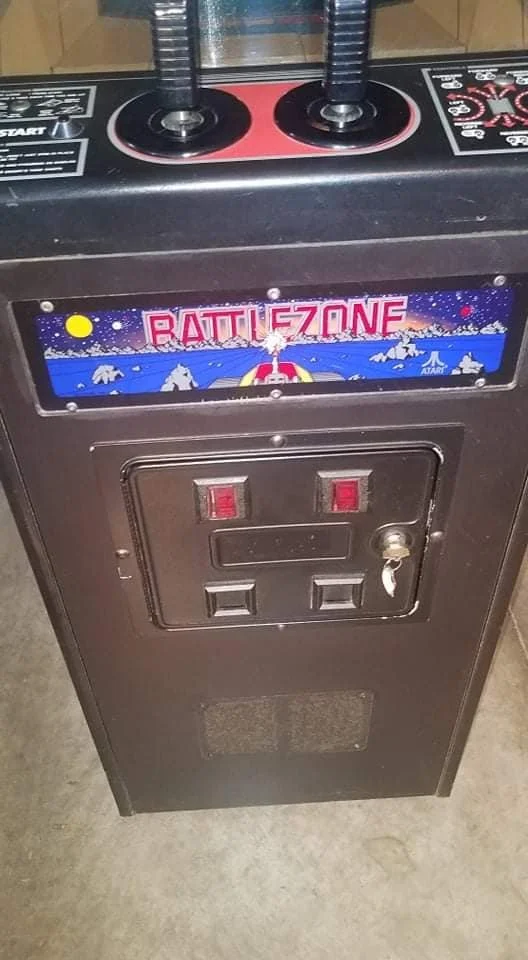
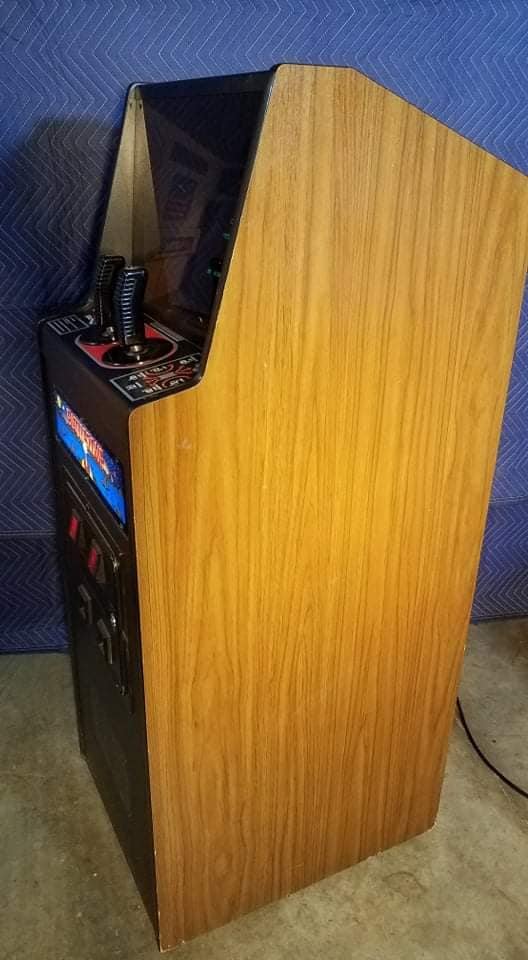
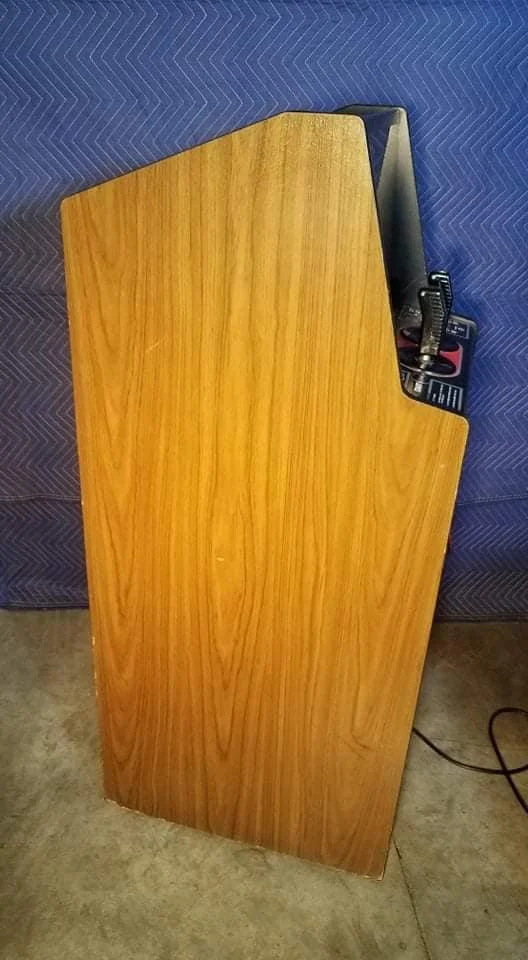
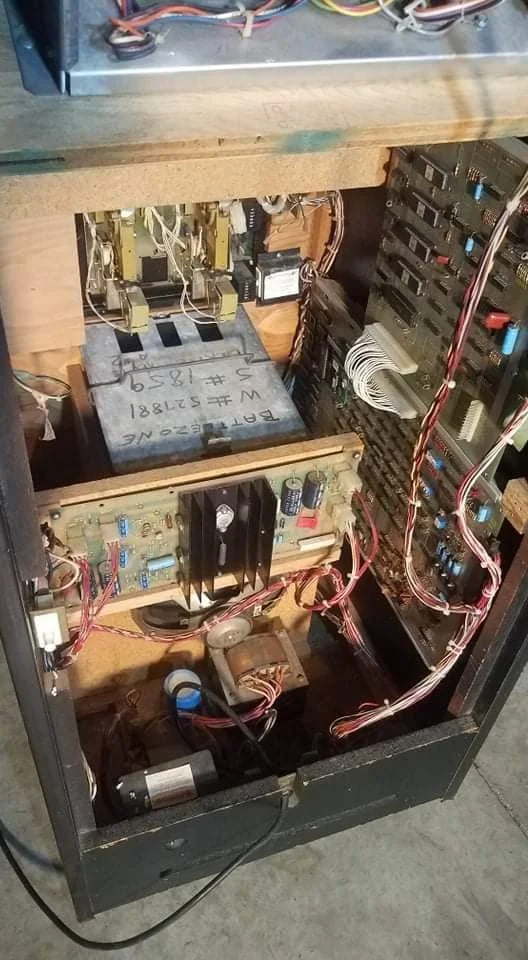
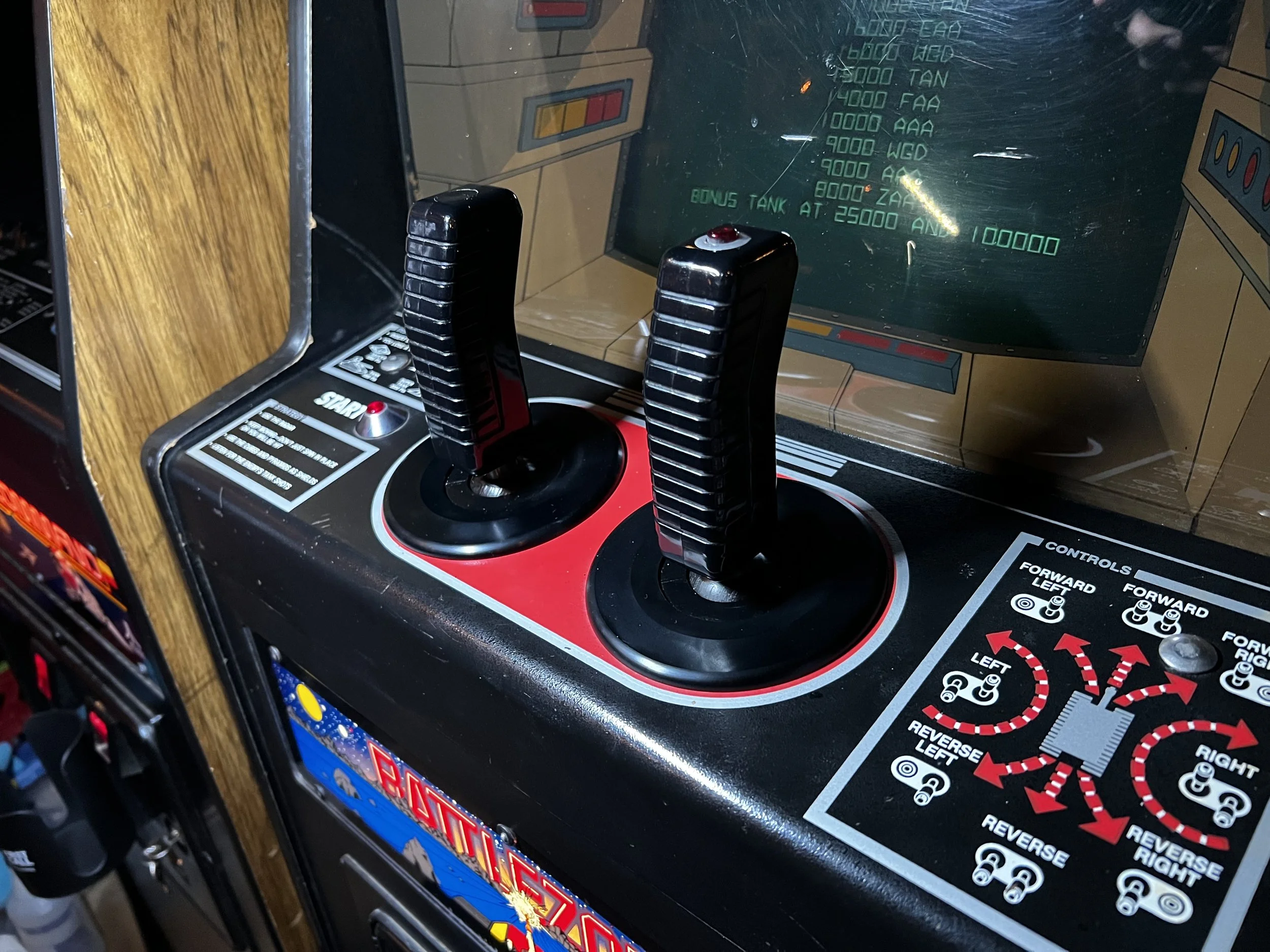
Ever since I fell in love with Ready Player One (the book) I’ve wanted to have a Battlezone cabinet (Planet arcade, reference) but my basement can be a little limiting in cabinet size. I’m stoked to be the proud owner of a Battlezone Cabaret!

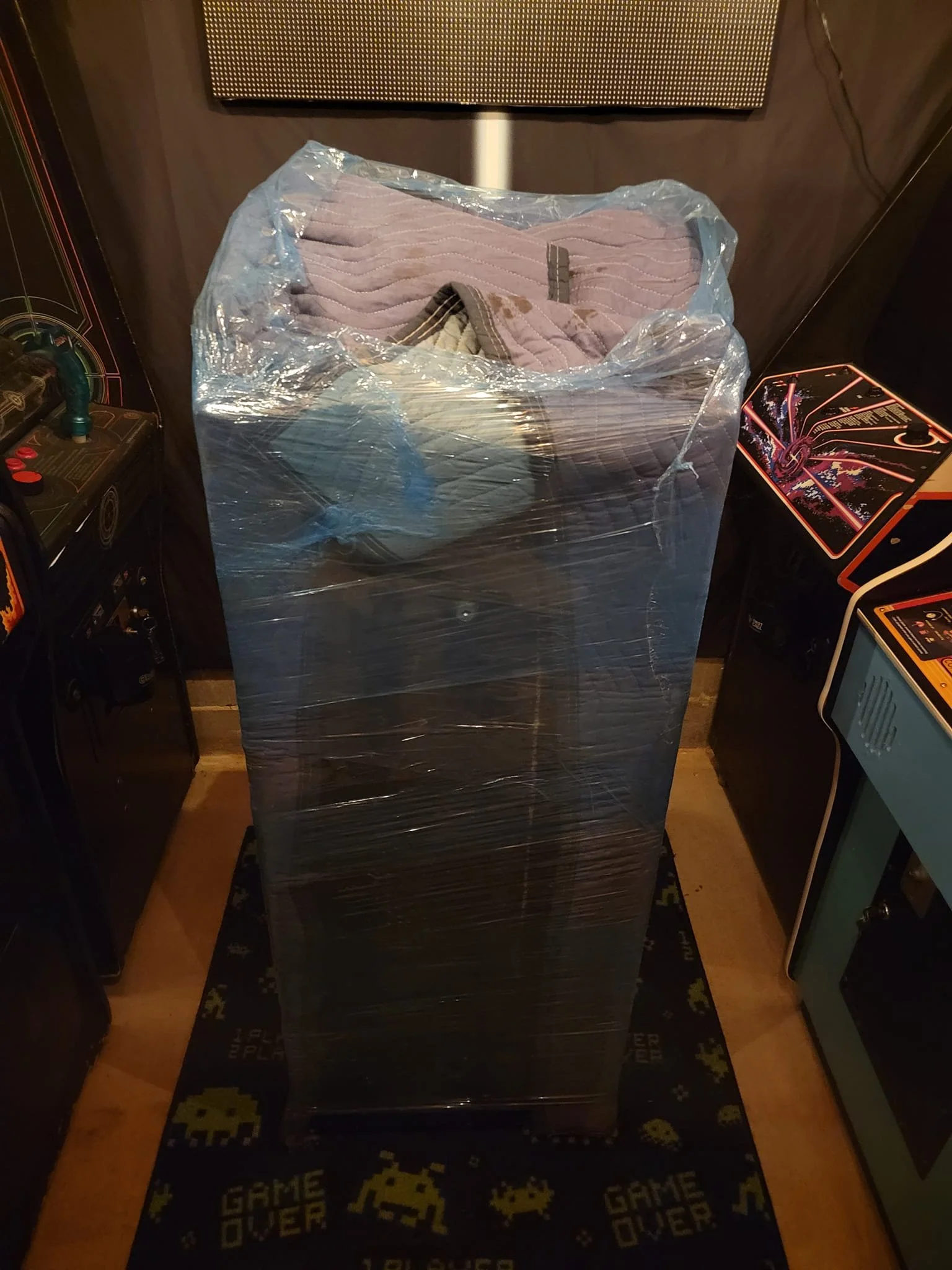
Santa’s Sleigh!

Control Panel Stuff

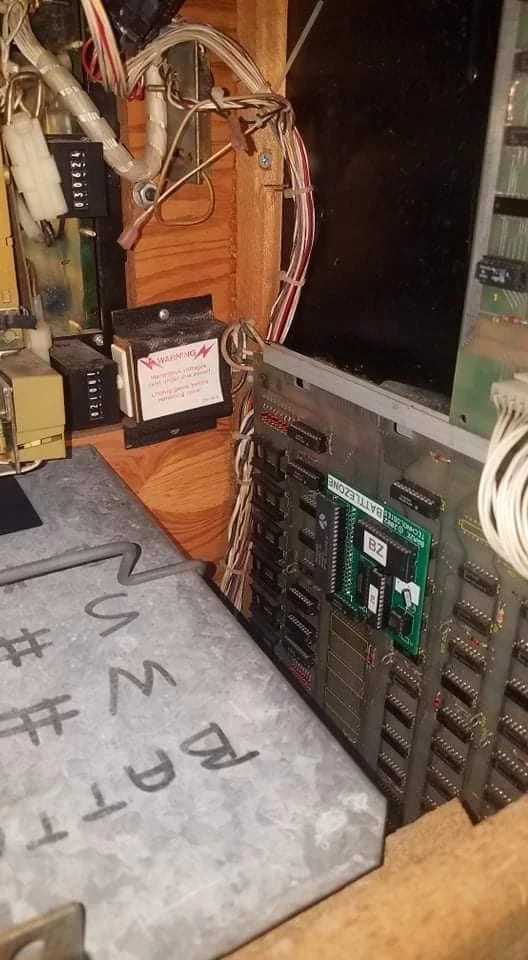
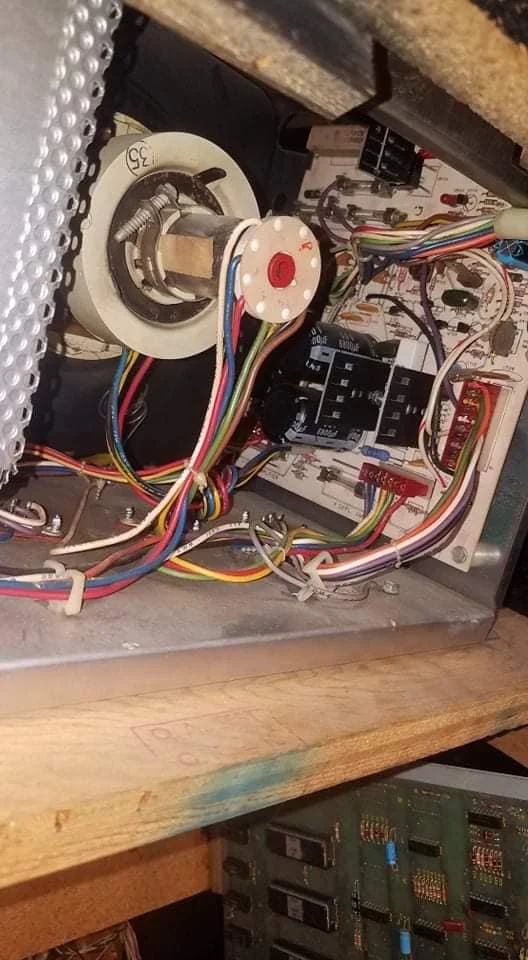
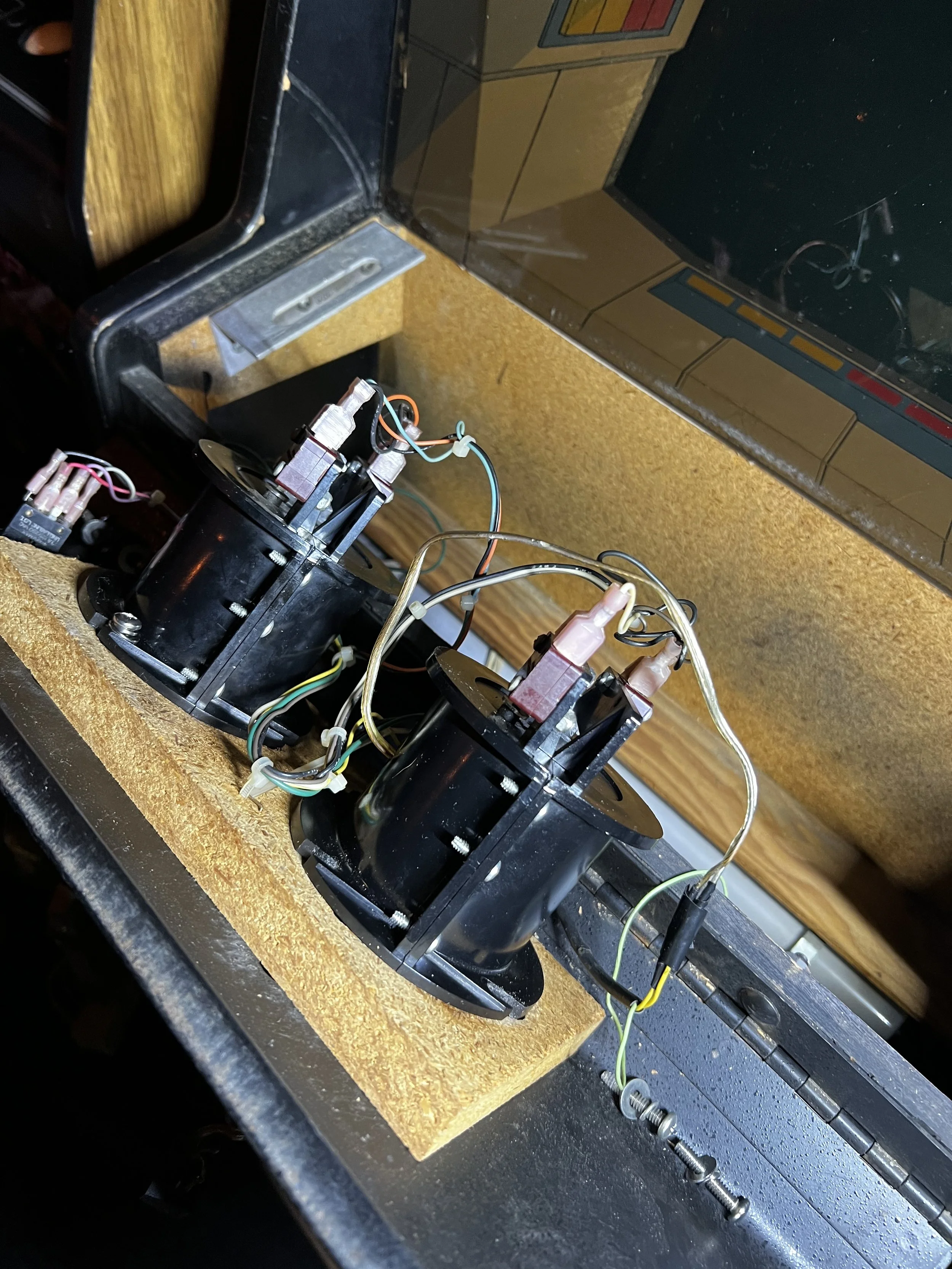
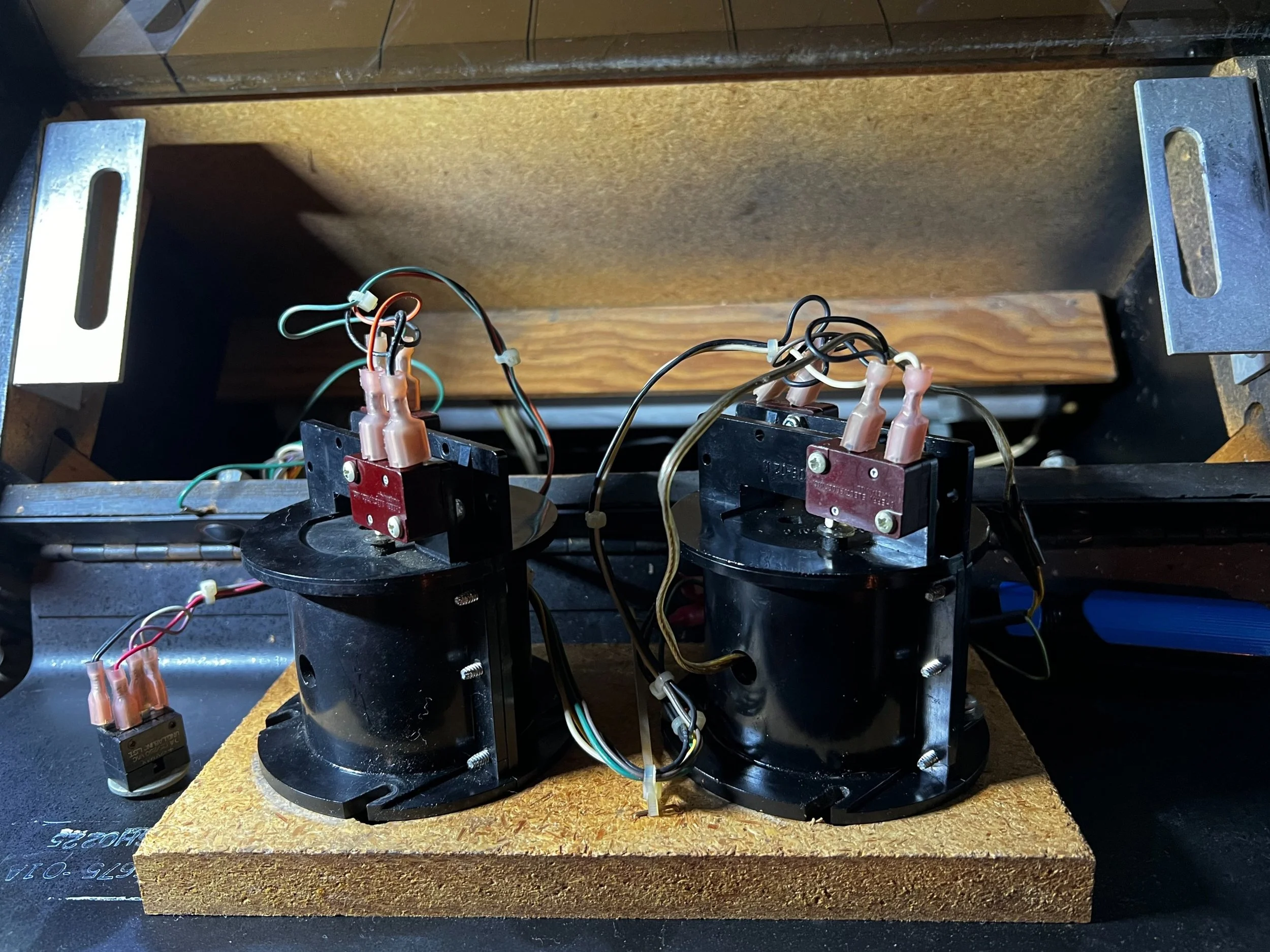
Given the age of the machine and general reputation of frailty of the control parts, I was happy that it was mostly in tact and working.

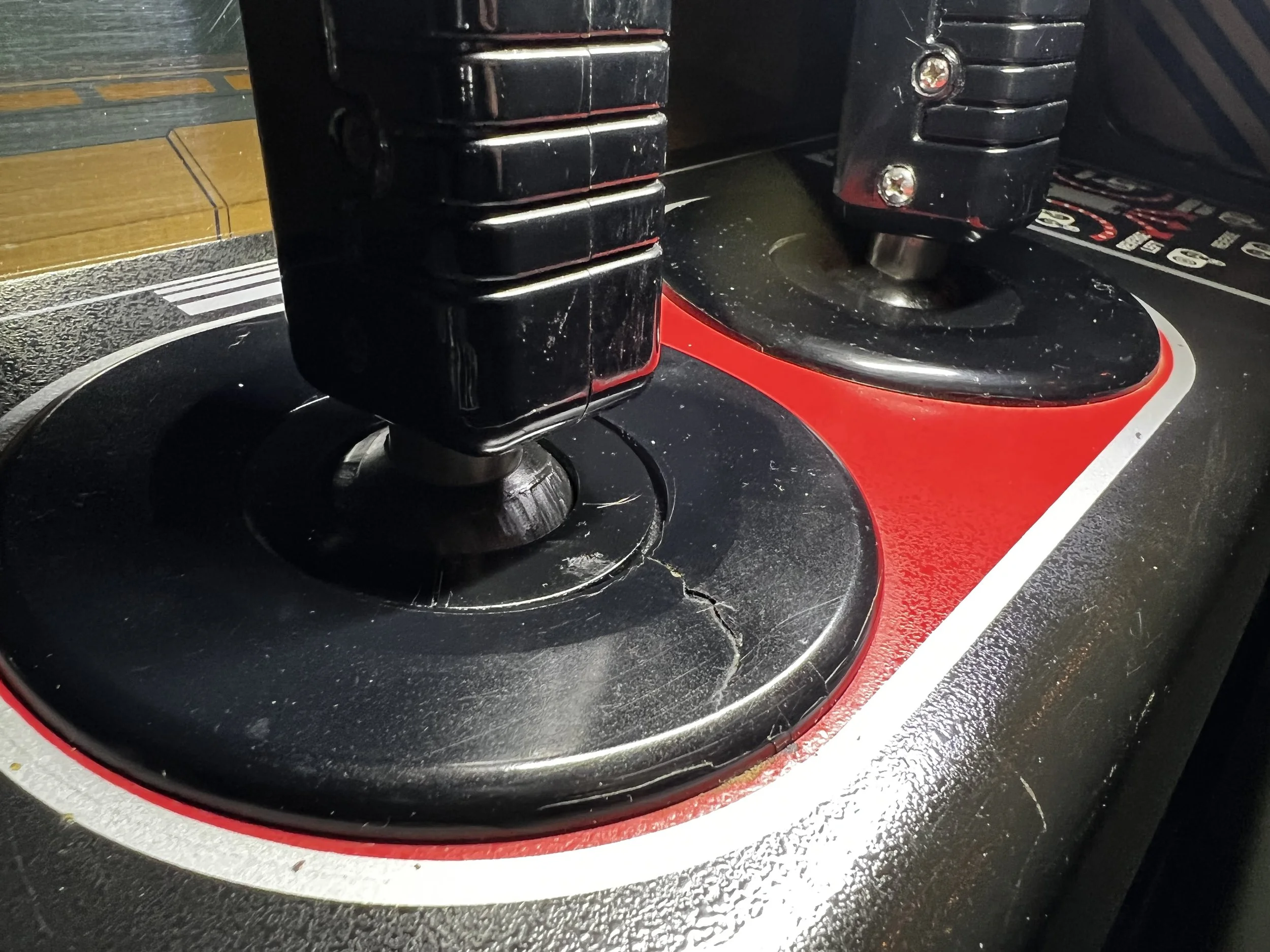
The right stick appeared to have no real resistence on it and the left stick felt pretty good. The screws had been replaced on one.

A little research seemed to show that getting game-specific parts would be a little bit of an easter-egg hunt shit-show. It seems that the NOS control panel parts in the community are highly overpriced ($90 for the control panel disc- with free blemishes) and that many of the parts are out of stock or difficult to find.

Awhile back, aluminum reproductions of the CP stick surrounds were made by some enterprising individual but the parts were marred in drama related to unfulfilled orders, reports of burned buyers and general sketchiness. The bellows (big rubber grommet thing) were being reproduced by a well-meaning community member but I didn’t hunt down exactly where to find them.

The Bellows / Grommet-Thing

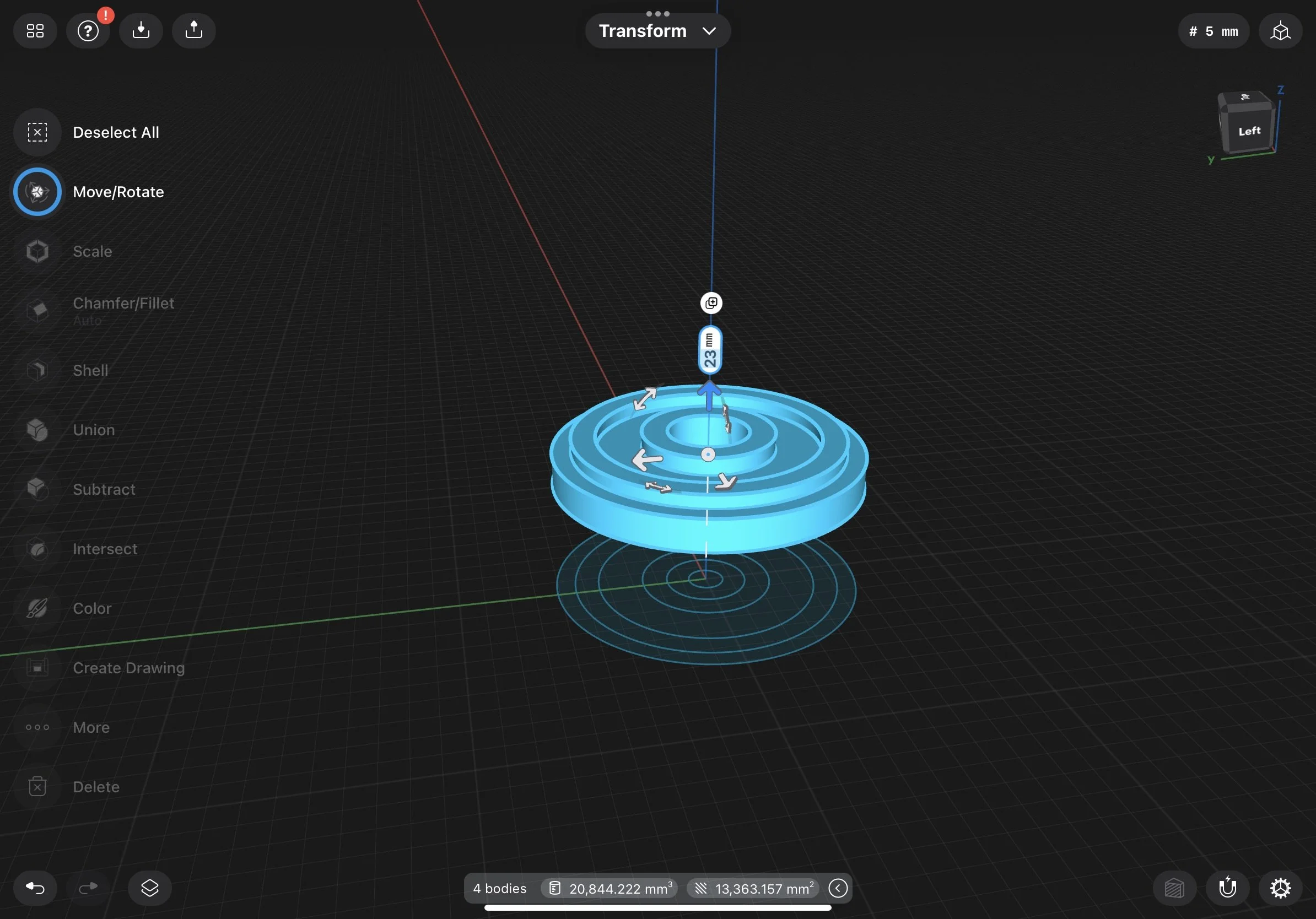
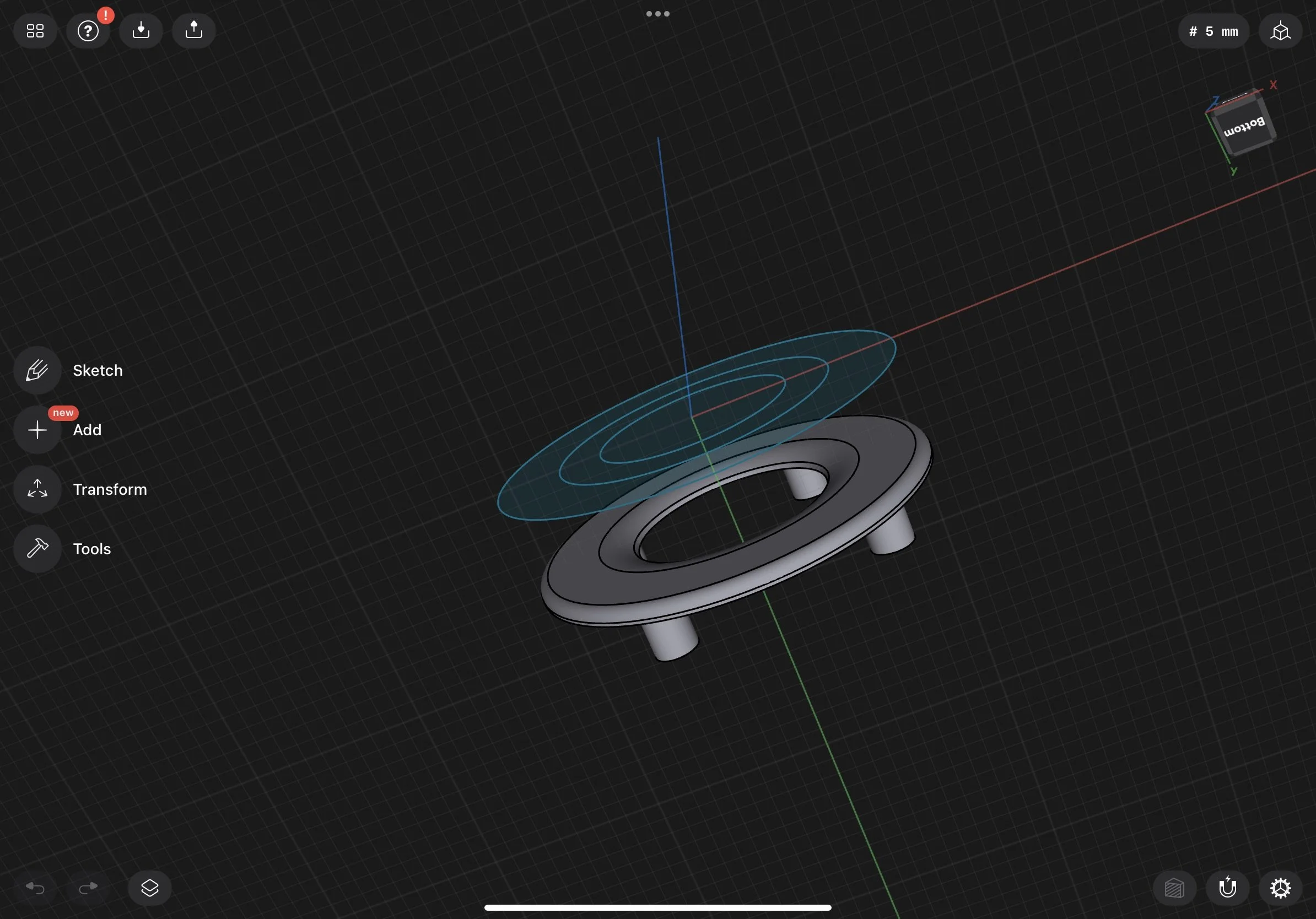
The reason that my right stick was floppy (umm…) was b/c the rubber bellows grommet-thing was blown out. I started here, taking rough measurements with the optical meat-orbs in my head and more detailed measurements from the original part with a micrometer and using a 3D Scanner. I then rebuilt the part in Shapr3D out of primitives by slicing and tracing the scan until the dimensions matched my original broken grommet.

The original is constructed from inner and outer stainless steel metal rings glued to a rubber insert. For convenience and time: my replacement part is one piece. It wouldn’t be difficult to reinforce but I’m hoping material science has improved enough in the last 40 years that my replacements will hold up. Might be inferior / might not - time will tell. At a cost of a couple dollars per print, I’m happy to replace it in a decade, as needed.

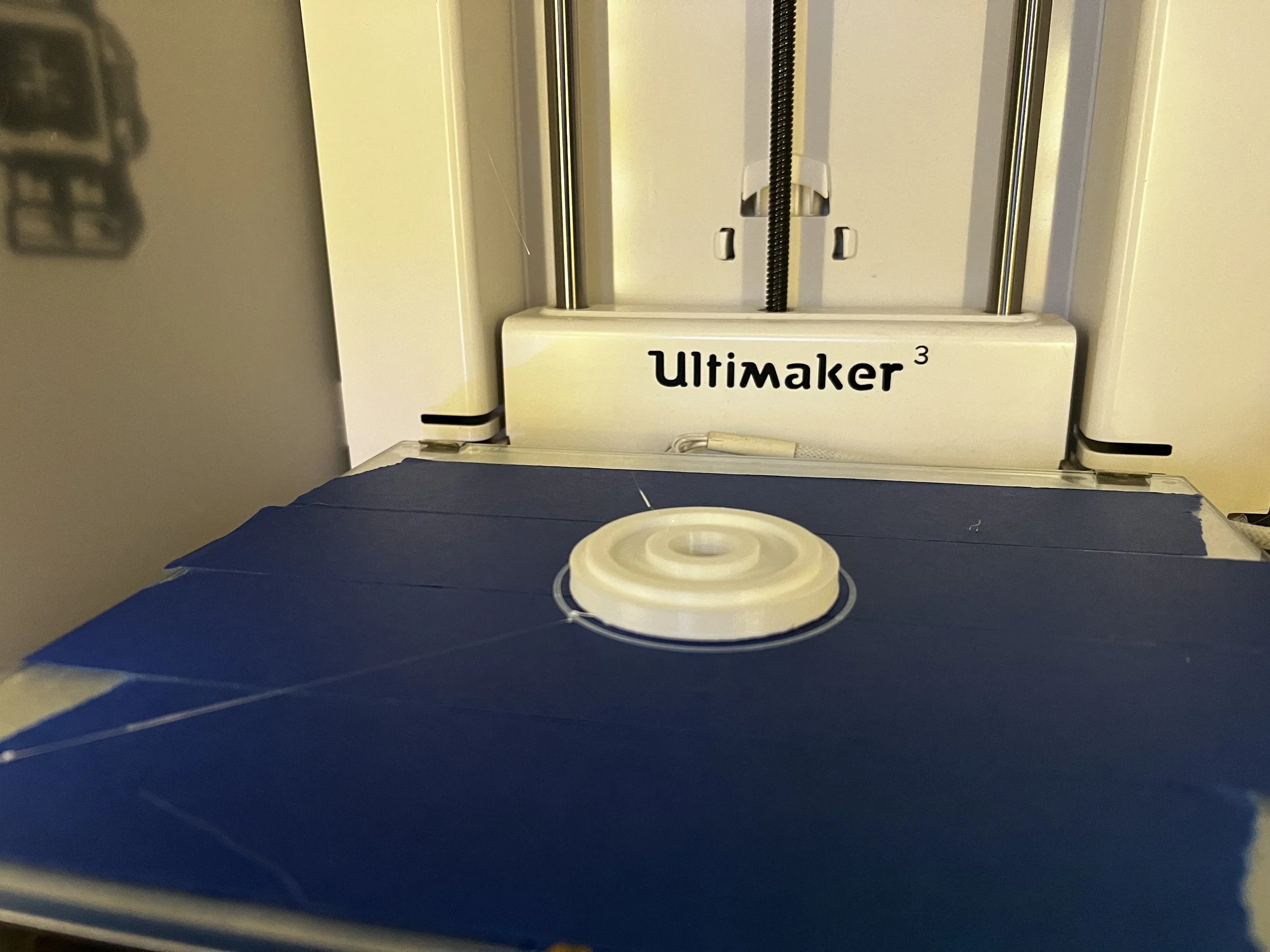
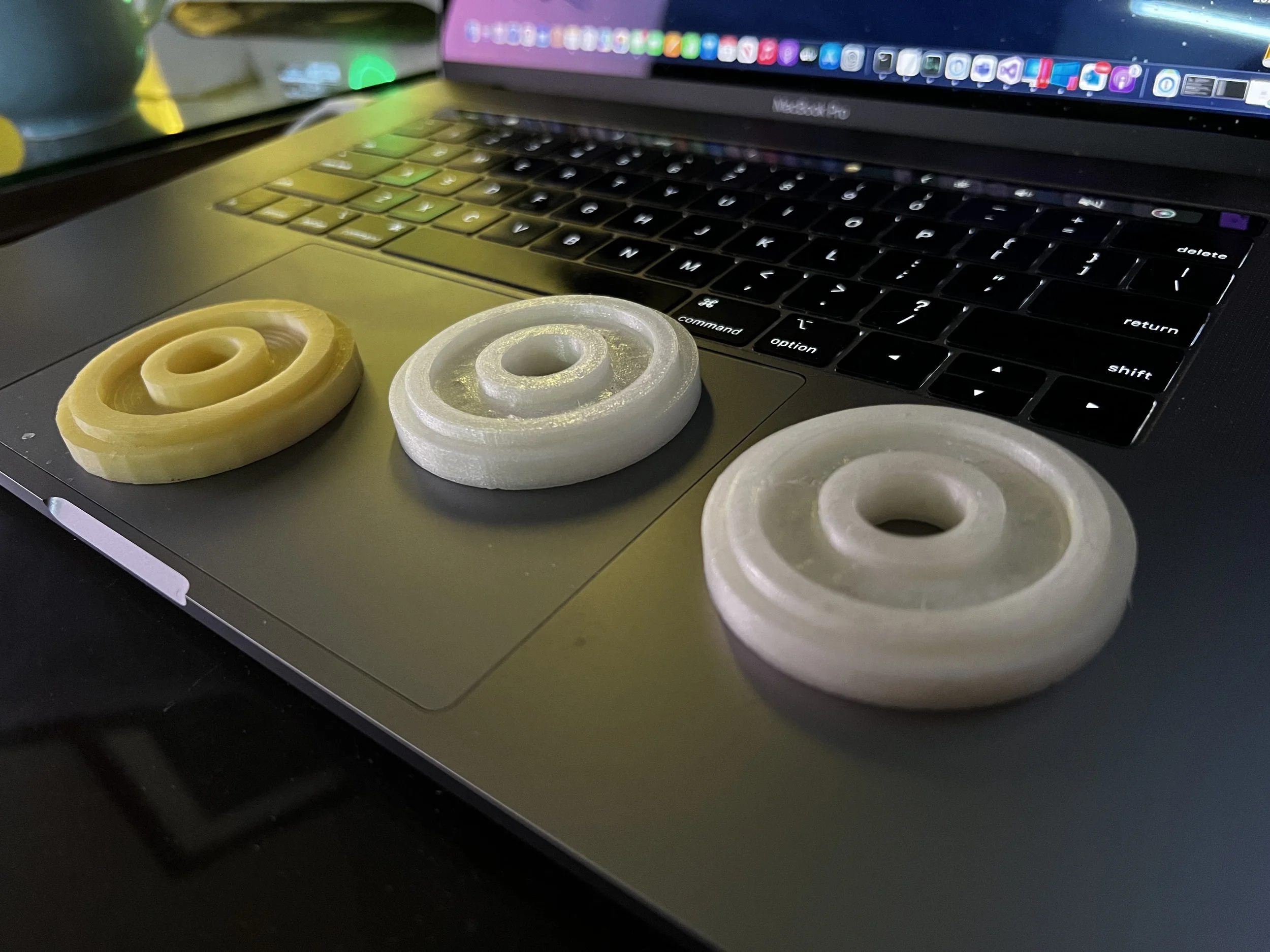
I printed a few with various types of TPU (flexible filament) - the NinjaFlex and Kodak Flex98 were my favorite. The Ultimaker Branded TPU95 I had was too rigid in the final print. Infill will help determine the resistance of the stick, I settled with Ninjaflex with a 20% infill for mine.

The Control Panel, Stick Bezel-Thing

The original parts (nylon, i guess?) on mine have thread insets for a 1” 10/24 course thread machine screws. The aluminum reproduction parts that are floating around in the arcade supply chain normally attributed to RAM Controls have the finer 10/32 thread insets.

B.Y.O.T. (Bring Your Own Threads)

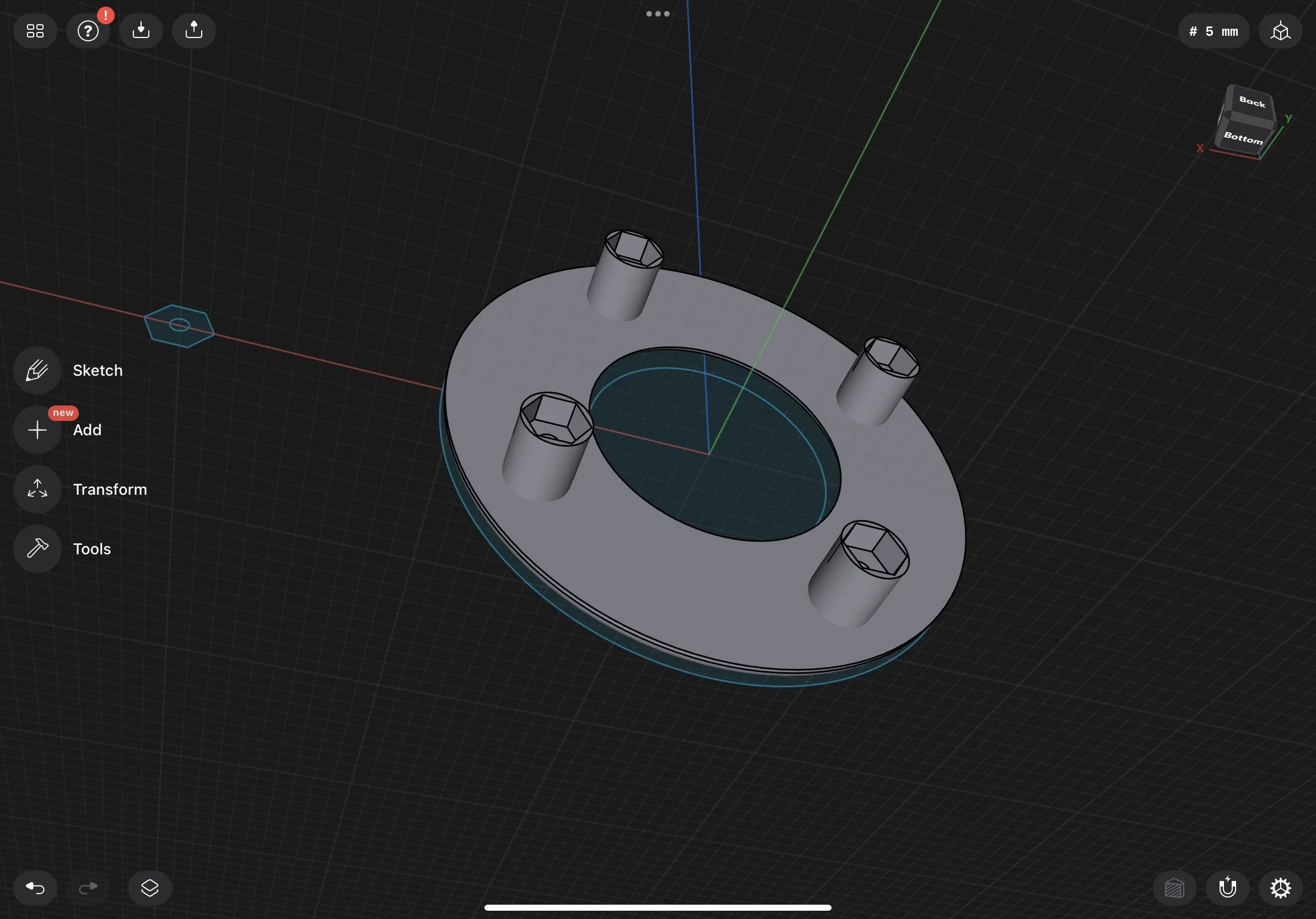
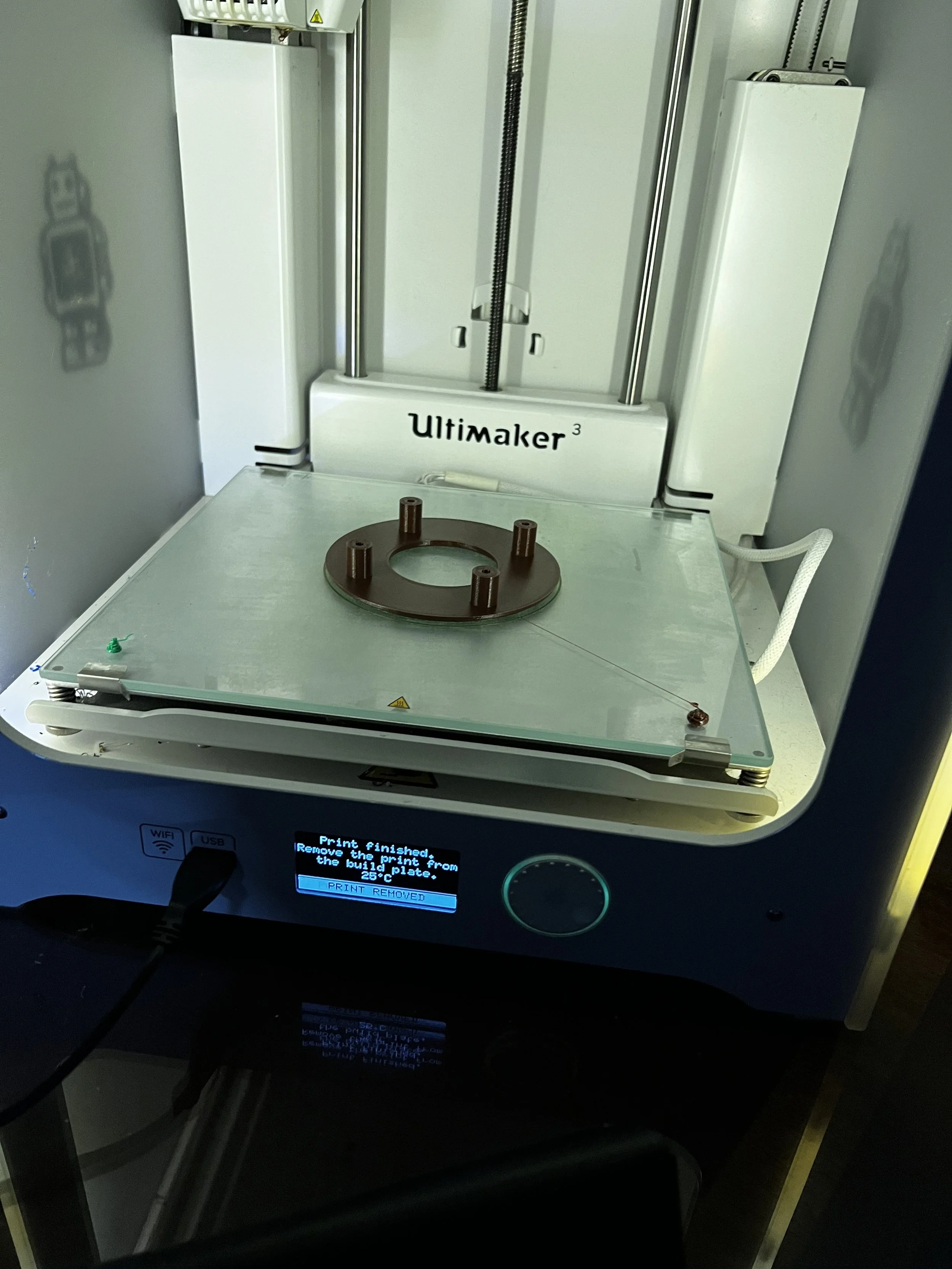
I painted my cracked original part with a flat spray paint to keep reflective errors at a minimum and did four scans of the original part. (2 close, 2 far, upside and downside) After importing them into Shapr3D, I rebuild the primitives using the original scans as a sizing template. For this version, you could thread the legs with a very hot screw or you could use it cold with a sheet metal or drywall screw instead of machine screw.

Glue-Nutty-Version

A made another version that can accept a #10 nut for threading. The idea being you could melt or glue a nut or standoff into the holes and use them to keep to the original machine-screw design. In order to accommodate the negative space to accept a #10 nut, the legs are slightly thicker (about .65 mm) than the original. I believe it would still fit in the original board but honestly, I didn’t test this one thoroughly.

PETG, Face down print - strong but a little stringy on the center cut-out bezel and internal camfer. Doesn’t play well with other materials as a scaffold.

Kodak PLA+. Very ABS-Alike in rigidity and finish, seems to work well enough with PLA or other PLA+ as a scaffold. Less stringy than the PETG. This is what I used in my final parts.

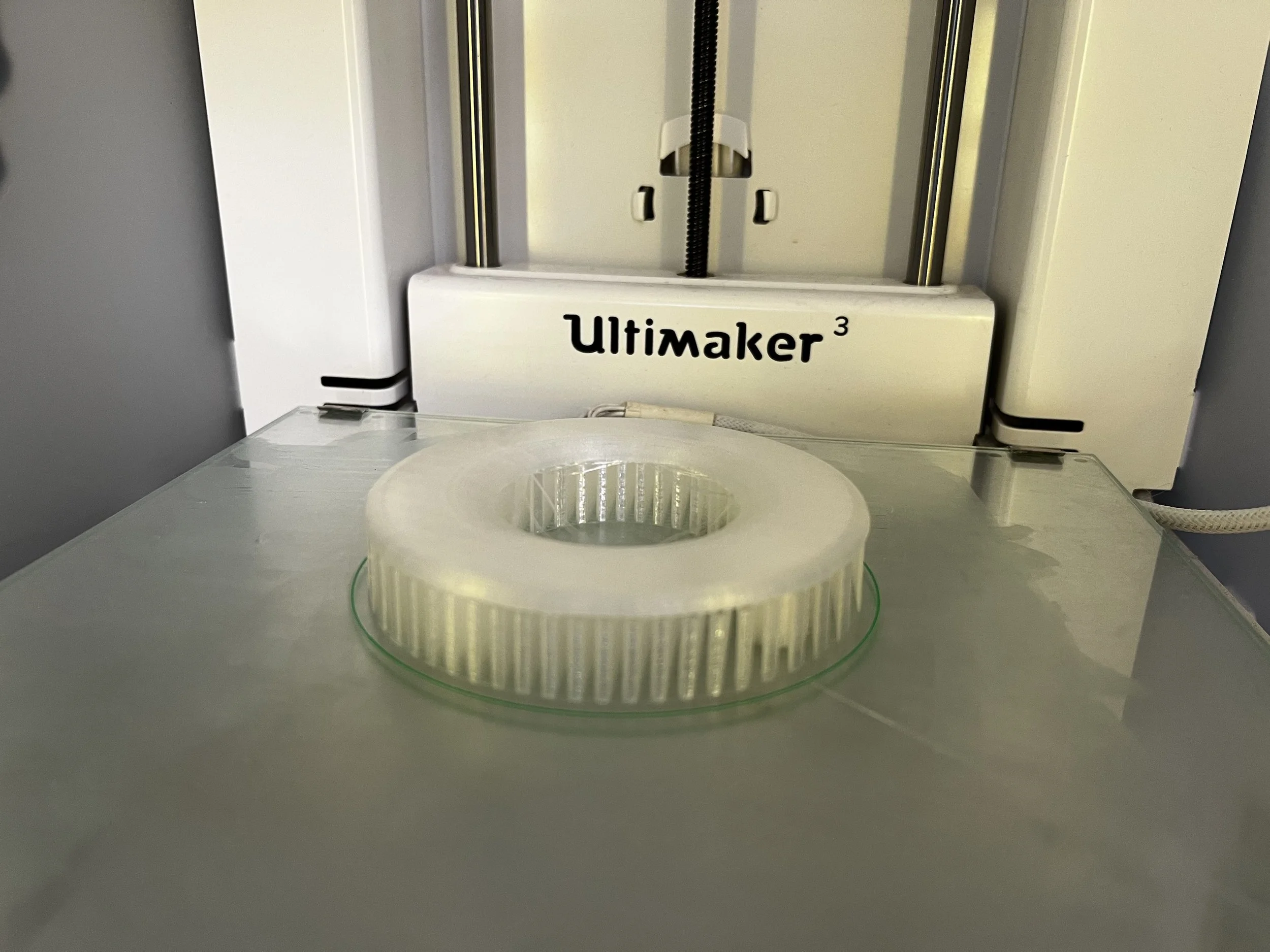
Getting a completely smooth finish out of a filament printer can be pretty tricky. Printed on glass, we tend to get waves from the adhesive substrate or printed with supports at a 180, you can get fine filament lines in the result. I’ve found that if I print it inside a dissolvable scaffold material (like PVA), you can end up with a pretty smooth surface. That is a trade off, though in that PVA doesn’t play nice with all build materials. I’ve also found that some materials (PLA+, ABS) tend to smooth out naturally or the lines are smooth enough that a few coats of paint do nicely to fill the 3d print lines.

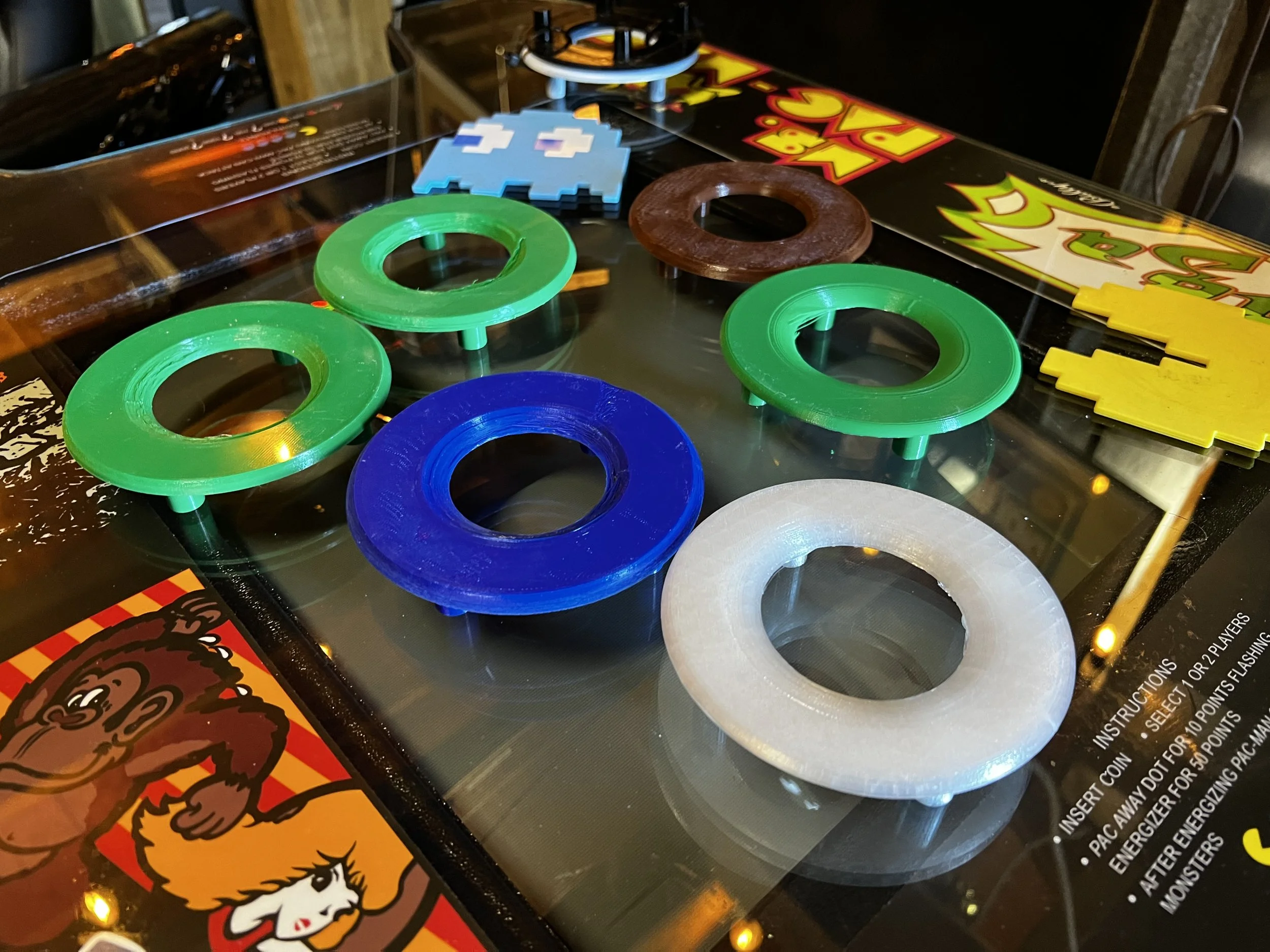
The original parts seem to have been Vinyl or Nylon (or something like it) but the way this part is used, really any material will suffice. I’ve tried PLA, PLA+, PETG, Tough PLA and Nylon. Nylon & Tough PLA would be strong enough to drive a small truck over but the extra strength comes with some tradeoffs in getting clean removal of support material, at least with my limited setup.

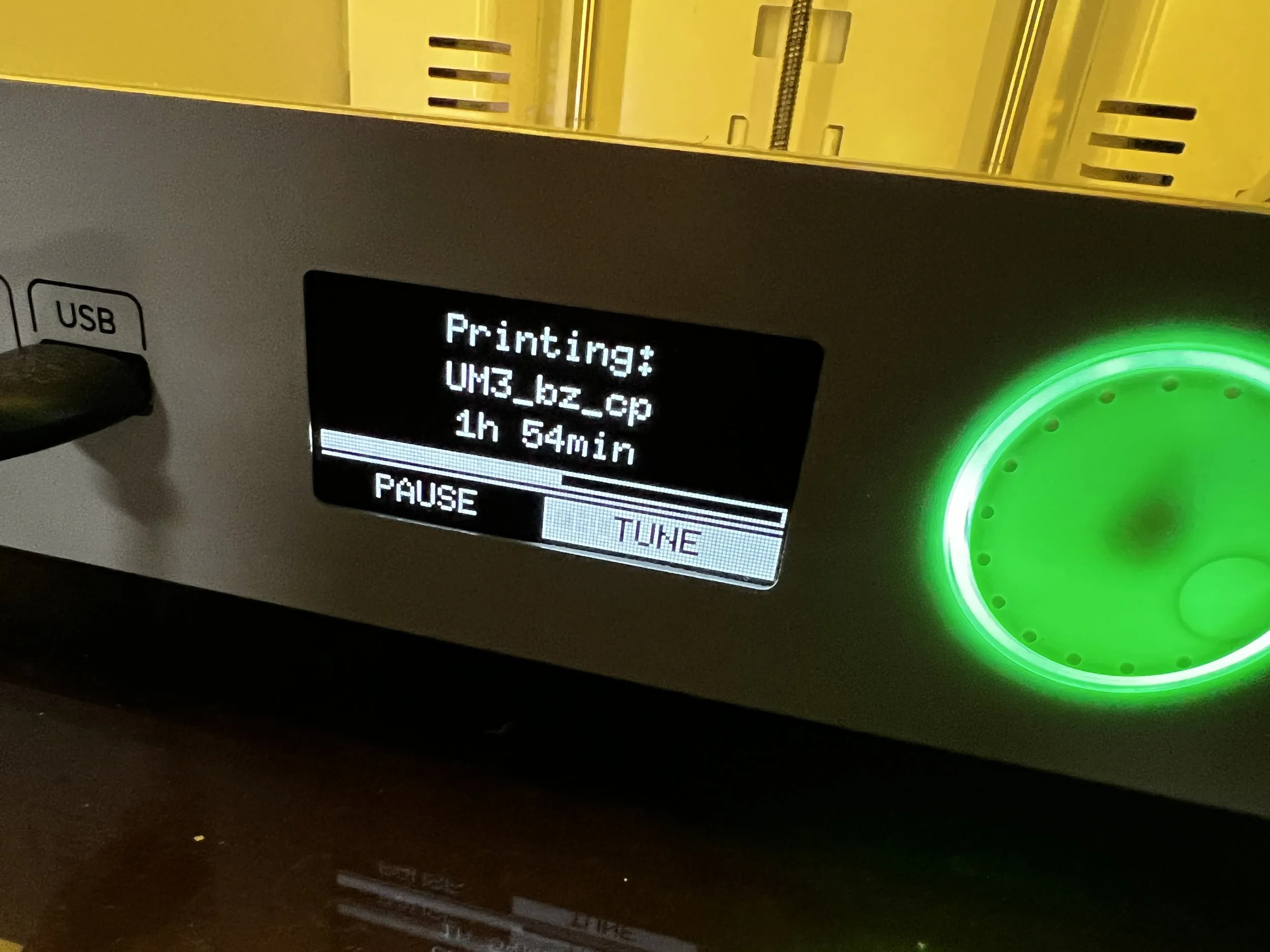
Kodak PLA+ was my favored result considering all things. Material cost comes out to about $2 and a 7 hour print job on my printer.

The Expanse

I’m going to keep this mostly spoiler-free because you just need to experience this as it is meant to be experienced.

The Expanse on Amazon Prime Video
The Book Series

Primary Factions and Overview

Earth has a unified government, the United Nations. Earth is crowded and the majority of the citizenry are on a subsistence-level universal basic income with better opportunities being doled via a series of Lotteries and internships.

Mars, a former Earth colony, comprises of citizens organized around terraforming and spreading the Martian work ethic and ideal. Their culture is marshal and collectively focused. Martians, in this case, aren’t little green men, simply 3rd and 4th generation of humans that colonized Mars.

The Belt is comprised of humans that have grown up outside of a planetary gravity well. These humans subsist as miners and engineers and their cultural touchstones are forged through experiences surviving in the vacuum of space. They settle asteroids and low-gravity moon bases, their language is a polyglot creole english-mashup with numerous cultural influences. Their physiology, living in low-G environments tends to make them taller and less muscular than their inner-planet counterparts but they tend to be scrappy and cunning warriors nonetheless.

The Inner Planets: Earth’s space-navy is dated but large. Mars space-navy is modern but smaller.
The Outer Planets and Belt lack a formal navy.

Story Overview

The First 3 Seasons (and Books) introduces us to a future (around 2350) where mankind has begun to exploit our solar system for natural resources. This first portion of the story uses a number of potentially interconnected mysteries to introduce the factions and setup tensions between those factions.

The story establishes and follows the Crew of the Rocinante, a Corvette-Frigate-Gunship and her unlikely crew as they coalesce and they unravel a series of mysteries in a politically charged, cold-war scenario. In addition to the crew of the Roci we are introduced to a slew of well-written characters to follow the perspective of the superpowers, the downtrodden and shadowy power-players with opaque motives and interesting pathos.

The storytelling here is fantastic with a great balance of political intrigue buffeted by impressive character work. The writers handle multiple POV characters with confidence and the characters feel realistic, aided by dense dialog and smart interactions. New viewers might find the Belter language difficult at first but it gets easier as the actors find their voice and the Belter Creole is well-justified through the in-universe cultural mechanics of the story.

As the mysteries of the first three installments unfold, the middle portion of the story shifts focus to a interplanetary gold-rush of sorts and all of the interesting things that happen when evolved chimps are given an unexpected boost in technical capabilities.

The last portion of the story explores the culmination and resolutions of the tensions of established factions, emerging powers as demagog leaders co-opt exploited populaces in an all-too-familiar power gambit.

Space is Brutal

One thing that makes The Expanse stand out from other sci-fi offerings is that the story tries to stay grounded when possible in physics. This isn’t a pew-pew-pew space-wizards sort of show. Space wants to kill you.

Critical Analysis

I’ve read the series twice (once in print and once on Audible), including the available novellas with their in-universe character gardening. I’ve also watched the series twice. The series has a lot of the same first-season challenges as the actors learn to inhabit the characters but also does impressively subtle foreshadowing of future events.

The series was on Sci-Fi through Season 3 and was sold to Amazon starting on Season 4. There are some mild location / set continuity shortfalls in the Amazon produced episodes but that is largely a nitpick. Probably some of the shooting locations were not available post-sale or potentially the practical sets didn’t convey to the new production.

The show is dense and demands your attention, you will become lost quickly in a background-watch scenario. Blink and you may miss it.

The effects work is really good throughout the series, lending towards realism with a few exceptions. The cast and crew really work their asses off and their love and dedication to the work shines through.

Themes, Concluding Thoughts

It is rare to find a Sci-fi series that competently juggles heady themes and even more rare to find a series with complex politics and a webwork of characters that sticks the landing. The Expanse does both. The writing duo got their start through affiliation with George RR Martin but haven written 9 books and stewarded their show to a satisfying conclusion, I wish George would tap them to help finish TSoIaF / Game of Thrones.

The Expanse TV Series effectively stops at the conclusion of book 6. Books 7, 8 and 9 cover the state of affairs after a significant time jump (~30 years) after the events of book 6. That said, the TV Series does find a satisfying conclusion despite the material left for future storytelling.

The Expanse explores themes of found family, prejudice, humanism, exploitation, radicalization, colonialism, acceptance, human suffering and grace; just to name a few. The show does a fantastic job of showcasing a diverse talent pool in a believable way with in-universe rationale. It does all this without coming across as preachy, hostile, or forced. The writers shine a light on the human condition and if you are uncomfortable with this reflection, then perhaps that’s the first step towards a better tomorrow.

More important that someone else's life gets better than for you to feel good about yourself. You never know the effect you might have on someone, not really. Maybe one core thing you said haunts them forever. Maybe one moment of kindness gives them comfort or courage. Maybe you said the one thing they needed to hear. It doesn't matter if you ever know. You just have to try.

-Naomi Negata

Further Analysis & Commentary

One half of the “James SA Corey” writing duo: Ty Frank & Wes Chatham: the actor that plays Amos have a great podcast:
Ty and That Guy

The duo has good friend chemistry, they spend about half of most episodes covering background detail about the episodes and production and the other half exploring their mutual love of cinema or storytelling, like hilarious recollections of trying to buy recreational drugs while on vacation in Costa Rica.

I give The Expanse 5 out of 5 Quarters.